“Kawhi up top. Looks at the clock. Turns the corner! For the win! Kawhi Leonard with the game winner!”
With 4.2 seconds left in Game 7 of the 2019 Eastern Conference Semifinals, Kawhi Leonard carried the ball around the top of the key, ran to the corner, and hit a buzzer beater to defeat the Philadelphia 76ers in the 2019 Eastern Conference Semifinals. The ball had bounced around the rim for what seemed like an eternity before ending the Sixers’ season.
The crowd in Toronto erupted into a roaring celebration of the miraculous shot, a stark contrast from Sixers fans.
Deafening silence.
A collective and overwhelming sense of stunned disappointment befell the city of Philadelphia, such that no one even moved. It was as if a hivemind controlled all Sixers fans and told them not to react beyond a singular denial of what had just transpired.
“I was at Kelly’s bar in Villanova,” said Pete Crossan, a Downingtown native and Sixers fanatic. “The whole bar froze. No one spoke. The sound wasn’t even disbelief at first, it was that hollow kind of silence that only happens when hope collapses all at once.”
In hindsight, it ended more than just a season. It ended an era and a revolution.
Sixers fans are no strangers to a loss. They had, after all, gotten to this point on a resumé rife with losses. “The Process,” the theory that the Sixers could escape a future of mediocrity, encouraged losing at its very core.
But this one felt different. It shattered resolve.
“When that shot bounced around the rim and fell in, the hope was gone. The emotional investment, the belief that maybe next year would finally be the one, it all bounced away with that shot,” said Crossan.
It finally broke a fanbase that had thought itself unbreakable.
____________________________________________
The Process
Sam Hinkie is somewhat of a folk hero in Philadelphia, sparking a shift in basketball culture in the city. His radical ideas garnered immense support from the team’s fans and utter disdain from the wider NBA audience, a type of villainy that the city so proudly embraced.
He arrived in Philadelphia in May 2013 in the midst of stagnation. The Sixers were not quite contenders for a Finals appearance, nor were they bad enough to draft franchise-altering players. They were in the NBA’s “No Man’s Land.”
The task at hand for Hinkie was daunting: take a roster devoid of top-end talent and transform it into a perennial championship contender.
His plan was simple to understand but not simple to sell. Professional sports franchises and their fans typically want to win. The Sixers were going to lose, and they were going to lose a lot.
Hinkie proposed a radical idea to lose on purpose. In 2013, a publicly acknowledged tank, especially at the magnitude and length Hinkie proposed, was unheard-of.
“It’s easy to forget how radical The Process was at the time,” said Crossan. “Losing on purpose, stockpiling picks, rejecting ‘win now’ pressure…it flew in the face of everything the league wanted in terms of competitiveness and marketability.”
By losing as much as they could, the Sixers would inherit the opportunity to draft players high in the lottery. In conjunction, the Sixers were going to trade their good players to accrue additional picks to either select more developmental players or to package in future trades for stars. The idea was built on probabilities, statistical analysis of the likelihood that a pick would convey, a player would develop, or a season would end with a Larry O’Brien trophy.
The question was if the Sixers and their fans had the stomach to endure consistent ridicule and doubt. What happens when your favorite team is reduced to a probability experiment? Especially in a “basketball city?”
At the outset, it was a proudly defiant revolution against the NBA for a team named aptly after a revolution itself. But the Sixers’ experiment was called “The Process,” not “The Result.”
The results are bleak.
“For years after the Allen Iverson era ended, the Sixers were within range of the playoffs, or in by a hair as a 7th or 8th seed, but never a serious challenge. They were stuck in purgatory. Good enough to hang around and get a first round’s worth of playoff revenue, never really relevant in a meaningful way,” wrote CBS’ Matt Moore in 2016 during a reflection on Hinkie’s tenure with the Sixers.
The Sixers remain right where they began.
During Hinkie’s tenure from 2013-2016, the Sixers posted a paltry record of 47-195. The losses were expected but so was playoff success, at least down the road.
But what playoff success do Sixers fans have to show for their commitment to an era of sustained losing?
Their deepest playoff run remains an ill-fated triple bounce in Game 7 against Kawhi Leonard’s Raptors in the 2019 Eastern Conference Semifinals.
In terms of stockpiling picks to increase the probability of finding a superstar, the Sixers improbably squandered their chances. The Sixers acquired two separate first overall selections in the NBA draft and walked away with Ben Simmons and Markelle Fultz. Fultz now plays for the Sacramento Kings, his third team since entering the league, and boasts a career-best point per game mark of 14.0.
Simmons no longer plays professional basketball.
Where the Sixers failed in finding talent through the draft, they did not make up via trade or free agency. Former Sixer Jrue Holiday won a championship with the Sixers’ greatest rival, the Boston Celtics. Fan favorite, TJ McConnell, was one game short of winning a Finals MVP for the Indiana Pacers.
Instead, the Sixers chose failed relationships with James Harden, Jimmy Butler, Tobias Harris and Al Horford, all while wasting the prime of their lone superstar’s career, Joel Embiid.
An abject disaster.
The Process’ course towards failure hinged on a few seminal moments, moments that crushed a city and ultimately defined a legacy of failure.
____________________________________________
A Sacrificial Lamb
Sixers fans bought into the idea of The Process. For a team that planned to lose so much, it was the promise of a dominant future that kept fans aligned with The Process’, well, process.
Ownership, on the other hand, was not prepared for the league-wide ridicule that followed. Neither was the NBA’s league office, an office whose commissioners have a history of inserting themselves into the business of its member teams.
Sixers’ ownership had actually considered hiring Sam Hinkie a season before they ended up doing so. As Pablo Torre reported for ESPN in 2015, Sixers’ owners Josh Harris and David Blizter had previously been impressed with Sam Hinkie’s ideas. “As a veteran of finance, [Hinkie] was fluent in the dispassionate language of expected value and probability,” Torre wrote. “Hinkie believed, as Harris and Blitzer did, that the process leading to a decision should matter more than the result.”
For as much as the owners were impressed by Hinkie’s beliefs, there was a lingering problem that had kept them from hiring Hinkie a season earlier. “As much as they were charmed by Hinkie’s abstract ideas, they couldn’t help but think skeptically,” Torre wrote. Their skepticism remained throughout Hinkie’s years at the helm.
The Process performed well. The Sixers amassed an incredible amount of draft capital and assets to set The Process up for success. In a letter to the owners of the Sixers in 2016, Hinkie pointed out that within the Sixers’ first 26 months of The Process, they added more than one draft pick or pick swap per month. Additionally, they received some of the best draft lottery luck in the history of the NBA.
Shockingly, fans remained positive about the progress The Process was making, especially the younger Sixers fans.
“Younger fans were much more supportive,” said Mike Sielski, a columnist for the Philadelphia Inquirer who’s covered the Sixers for more than a decade. “This is proving truer the further away from The Process we get. The bitterness that most Philadelphia fans felt really before Eagles won the Super Bowl comes from the Phillies collapse in 1993. That moment scarred fans for years. The baby boomers and Gen Xers became very bitter and skeptical about everything. They are inclined and conditioned to say that this sucks, everything sucks. Younger fans had experienced the Phillies winning the NL East, the World Series, and the Eagles winning the Super Bowl. Social media made it more acceptable to be an optimistic fan.”
But the successful set up for The Process and positive momentum was not enough to save Hinkie from the hands of the NBA and the lack of commitment from the Sixers’ ownership group.
If they had known, fans may have anticipated the coming coup d’état.
On Dec. 6, 2015 the Sixers hired long-time NBA executive Jerry Colangelo as the Chairman of Basketball Operations, a position that oversaw General Manager duties.
ESPN reported the decision to hire Colangelo came when Josh Harris “wanted more than an opinion on what was wrong with his failing franchise.” Harris wanted Colangelo to “fix and save the Sixers as part of the front office.”
Not wanting to be held hostage during his process, Hinkie resigned as General Manager just four months later, on April 6, 2016.
Hinkie wrote a 13-page resignation letter. In it, he raved about the potential future of the Sixers, of what The Process had accomplished in just three years. Specifically, he cited the draft capital amassed over the course of The Process, the franchise’s growing international pipeline, and most importantly, the potential of the crown-jewel of The Process, Joel Embiid.
The letter cemented Hinkie’s folk hero status in Philadelphia. Fans, rightfully, were distraught by his unexpected departure.
“I think part of the loss of faith in The Process came from how the organization handled Sam Hinkie,” Crossan said. “Fans were still bought in, even through the losing, because there was a plan. But when ownership forced Hinkie out and brought the Colangelos, it was a clear sign that they didn’t believe anymore. The front office lost its nerve before the fans did.”
Amateur Philadelphia sports blogger and podcast host Mitchell Warner did not think the Colangelo hire and Hinkie resignation was just the franchise’s decision.
“We never got to follow through with The Process as a team building idea,” he said. “It was chopped off at the knees when the organization fired Hinkie. They forced the Colangelos on us as a punishment for The Process.”
If the hiring of Colangelo was in fact a punishment for The Process, it was damning. Because Hinkie was not able to see The Process to its completion, it was doomed to failure.
Despite Hinkie’s stockpile of future draft picks, they came away with only one franchise-altering star. Colangelo oversaw The Process during the 2016 and 2017 drafts, selecting first overall in both, but trading away an additional first round pick to move up to select Markelle Fultz in 2017.
“Embiid was the only truly great player they got,” said Sielski.
Crossan believes it was the change from Hinkie to Colangelo that signaled the end of The Process’ core tenets.
“The second Colangelo took over, you saw the shift. Win sooner, get star names, speed it all up. And that’s when the cracks started to show,” he said.
____________________________________________
Nepotwitterism
Sixers fans’ skepticism surrounding Jerry Colangelo was met almost immediately with justification of their fears.
Just after Jerry Colangelo usurped Sam Hinkie at the helm of The Process, ESPN Insider Brian Windhorst reported that owners across the NBA had “been lobbying the league’s front office to step in with regard to the direction” that the Sixers were taking. Windhorst further reported that “NBA commissioner Adam Silver was instrumental in forming the partnership between Colangelo and 76ers owner Joshua Harris.”
In the minds of Philadelphians, the correlation between Jerry Colangelo and intentional franchise sabotage was strong.
“The NBA stepping in and essentially installing Bryan Colangelo felt like outside interference into something organic,” said Crossan.
A sham General Manager search did not help assuage Philadelphia’s suspicions. After Hinkie resigned, Jerry Colangelo led a “search” to fill Hinkie’s empty General Manager role. After conducting a reportedly thorough search, Jerry Colangelo finally settled on hiring Bryan Colangelo, his son.
Bryan Colangelo’s time as the Sixers’ General Manager had some ups, but mostly downs. Among his most notable shortfalls was his inability to draft stars, despite having two attempts to do so with the first overall pick in the NBA Draft.
During the 2016 NBA draft, Bryan Colangelo drafted Ben Simmons first overall. Notably, Bryan Colangelo could have selected Jaylen Brown, Jamal Murray or Pascal Siakam, all of whom have since won a championship with the team that drafted them. Simmons’ failure to develop as a shooter would later cost the franchise dearly.
Just one year later, Bryan Colangelo made a trade with the rival Boston Celtics to move up to the first overall pick. This time, Colangelo selected Washington guard Markelle Fultz. Colangelo passed on the opportunity to draft Jayson Tatum, Lauri Markkanen, Donovan Mitchell and OG Anunoby in favor of Fultz, who suffered thoracic outlet syndrome. The rare injury deteriorated Fultz’s shooting form, from which he never recovered and was eventually traded to the Orlando Magic.
Yet, for all of his shortfalls as a team builder, Bryan Colangelo’s biggest failure was the toxic culture that he fostered in the locker room, evident in one of the most bizarre scandals in NBA history.
On May 29, 2018, the Ringer’s Ben Detrick reported that an anonymous source informed him that Bryan Colangelo was using burner Twitter accounts, leaking sensitive information and making disparaging comments about Sixers players and other General Managers in the NBA.
Detrick reported that for all of the Sixers’ improvements during the 2017-2018 season, the burner Twitter accounts “anonymously [sparred] with the media and [defended] Colangelo’s reputation” as well as “tipped team strategy.” Detrick claimed that “together, these acts, if true, could be severely damaging to Colangelo’s organization and amount to a huge breach of trust between him and the people he oversees.”
Detrick reported that one of the burner accounts “liked a tweet that advocated sending the No. 3 pick and the 2018 Lakers pick to Boston for the top selection, but without including Dario Saric. If rival teams were aware of this account, it had publicly broadcast the Sixers’ strategy a full month before the NBA draft.”
Not only did the burner accounts potentially leak team strategy and breach the trust of the organization and its players, it also raised the alarm for fans of The Process, who saw the scandal as another critical indicator of a failing franchise whose direction was changing for the worse.
To fans, it reinforced their fear of a NBA league office out to destroy their process.
“I think he was sent to us with the knowledge that he was going to be bad at the job of rebuilding the Sixers. Or at least kind of bad. The league has always been against The Process,” said Warner.
As with any scandal, the organization scrambled to find and disseminate answers. Sixers ownership hired a private firm to investigate if the accounts were, in fact, Bryan Colangelo’s. The firm found that the accounts were Bryan Colangelo’s wife’s.
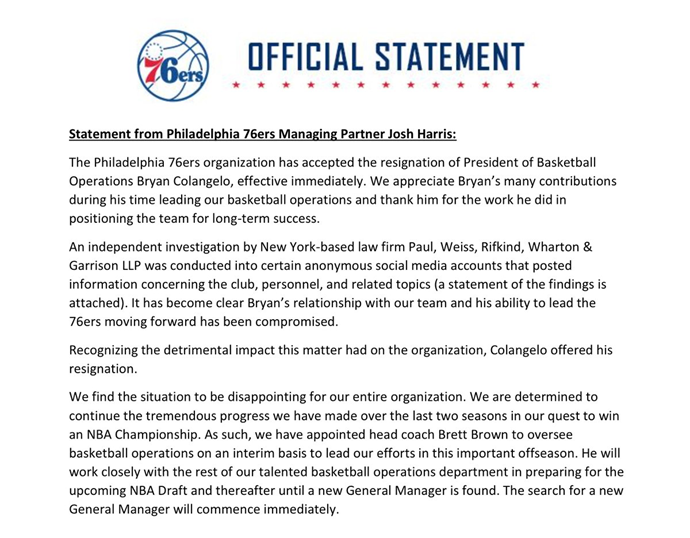
Whether the accounts were Bryan Colangelo’s or his wife’s, the relationship between the Sixers front office, the players and the fans was dealt a critical blow.
The dysfunction between players, coaches, the front office and owners exposed in the tweets was an indictment on ownership and pointed to organizational failures.
The Process was failing.
____________________________________________
Passing By
“These Sixers are conspicuously long-limbed…approximately none of them can, you know, shoot. This is no accident. It remains scientifically impossible to develop arm length, an underrated characteristic on defense. (‘Sam is very studied in regards to that,’ Brown says.) But as Spurs wing Kawhi Leonard has verified, it is possible to grow a prospect’s shooting ability over time. And Philly, forcing turnovers at a league-high 15.6 percent through the All-Star break but shooting a league-low 41 percent, is incentivized to wait on such a large-scale renovation.”
Pablo Torre’s article on Hinkie’s philosophy references Hinkie’s team-building principle to gamble on length over shooting ability.
It is a gamble that did not bear a strong return on investment.
Perhaps the most glaring example of the fault in this principle is Ben Simmons.
Every summer, the Sixers promised Ben Simmons development. Every summer, Sixers fans heard about his expanded game. Every summer, Sixers fans flocked to grainy footage of Ben Simmons’ jump shot in summer shootarounds.
Yet after every summer, when the games actually mattered, Simmons did not deliver.
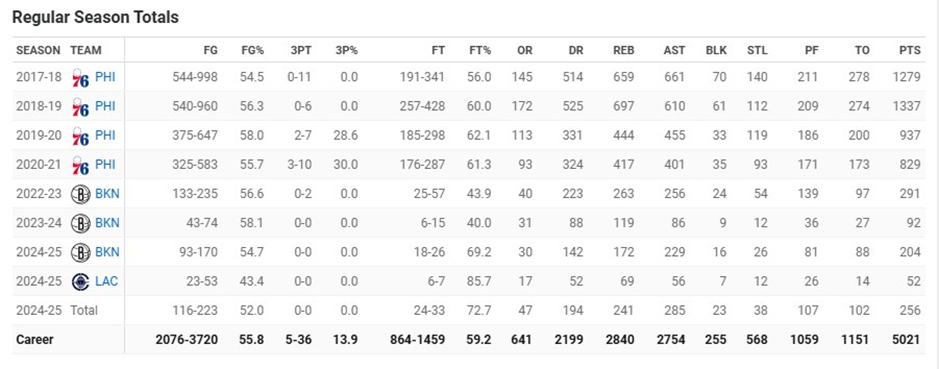
Over the course of his Sixers career, Simmons shot 5-34 from three, good for a 14.7 shooting percentage.
Simmons shot 809-1,354 on free throws, a putrid 59.75 free throw percentage.
Instead of improving, Simmons actually got worse each season after his 2017-2018 Rookie of the Year campaign. A player that once displayed so much promise collapsed.
Following the Sixers loss to the Raptors in the 2019 Eastern Conference Semifinals, the Sixers had a decision to make between Simmons and Jimmy Butler.
The Sixers acquired Butler around the trade deadline to help them in a championship run. They sent Process legends Robert Covington and Dario Saric to Minnesota in the trade. Butler performed well in Philadelphia and built a rapport with franchise-cornerstone Joel Embiid. Butler even almost saved the Sixers season against the Kawhi Leonard’s Raptors. He drove the lane and tied the game at 90 with 4.2 seconds left before Kawhi Leonard’s infamous shot.
Yet, rumors circulated that Simmons was unhappy with his role with Butler in the offense. Butler often controlled the ball on the court, relegating Simmons to a more passive role that Simmons did not prefer.
The Sixers acquiesced Simmons request and gave him a massive extension rather than keep Butler.
The Sixers traded Butler to the Miami Heat, who made two Finals appearances with Butler as their best player. He was lionized for his playoff performances.
Simmons, on the other hand, became infamous in Philadelphia lore for another seminal moment in the failure of The Process.
During the 2020-2021 season, the Sixers earned the 1-seed in the Eastern Conference. After defeating the Washinton Wizards in the first round of the Eastern Conference playoffs, the Sixers faced the 5-seed Atlanta Hawks.
The Sixers immediately squandered their home court advantage by losing Game 1 of the series.
The series went back-and-forth, forcing Game 7 at the Wells Fargo Center in Philadelphia. Throughout the series, Simmons struggled offensively. Critically, he was struggling mightily at the free throw line. The Hawks resorted to intentionally fouling Simmons when he had the ball, expecting him to miss at least one of his free throws.
With the Sixers down 88-86 in the 4th Quarter of Game 7, Simmons received a pass directly under the basket with only the 6-foot-1 Trae Young in front of him. For a player of Simmons’ caliber, strength and size, the wide open dunk should have been an emphatic slam that generated unstoppable momentum and shattered the Hawks’ resolve.
Instead, fearing he would be fouled and have to go to the free throw line (likely for a chance at a 3-point play), Simmons passed to an unexpecting Matisse Thybulle who missed the layup.
Simmons never mentally recovered from the 2021 Hawks playoff series, continuing to regress. The following season, the Sixers traded Simmons to the Brooklyn Nets. The Sixers’ prioritizing Simmons over Butler is an indictment on the Sixers’ organizational missteps.
Sielski points to the Simmons selection during the 2016 NBA Draft as further evidence of Sixers’ failing organization.
“[That is an] organizational [failure],” Sielski said. “I recently wrote a story about Ace Bailey and Dylan Harper. How good could Ace Bailey and Dylan Harper be? They are supposedly generational level talents but they couldn’t make the NCAA tournament? They should have seen that with Fultz and Simmons. How great can this kid be if his team is 9-22?”
The moment Simmons passed up a dunk over a 6-foot-1 guard, Sixers fans got the message: the Sixers’ franchise-altering players may not be the stars they wanted.
____________________________________________
The Final Nail
Video Credit: Did the Sixers Win?
Celtics-Sixers, an age-old rivalry.
This time, the showdown came during the 2023 NBA Playoffs. The Sixers were the 3-seed in the East and had just beaten the Toronto Raptors.
Sixers fans saw the Raptors series as a chance at retribution for the 2019 Eastern Conference Semifinals, when Kawhi Leonard sent the Sixers home on his miracle shot.
The Sixers had in front of them the opportunity to justify all the missteps during The Process by finally beating Boston in the playoffs.
The Celtics had the Sixers’ number. Boston had sent the Sixers home in both the 2018 and 2020 playoffs and had also claimed the majority of regular season matchups during The Process era. Joel Embiid even claimed in 2018, “this is not a rivalry…they always kick our ass.”
Not exactly the most inspiring words from the crown-jewel of The Process.
Surely, this time would be different. This time, the Sixers had surrounded Embiid with complementary pieces: guards that could shoot. Embiid was on his way to his first MVP honor. Despite all of The Process’ failures that preceded this series, there was still a small bit of hope among fans that Tyrese Maxey and James Harden could be the final pieces. This time, the Sixers had a chance.
Yet, nothing changed.
In fact, the series was the final nail in The Process’ haphazardly created coffin.
Sielski points to the series as the moment he knew that The Process era was over and that it was going to end in failure: “The moment I think of was Game 5 of the Eastern Conference Seminfinals in 2023. [The Sixers] go to Boston and they end up beating the Celtics. Embiid had a chase down block. It was an incredible defensive play. This is what everyone had been waiting for. Two nights later in Wells Fargo, they just don’t show up. It was the night that Embiid got the MVP award.”
Video Credit: Always Hoops
The Sixers had a chance to reverse the results of The Process. All of the failures that accompanied Sam Hinkie’s doomed team building philosophy could have all been forgotten. They won Game 5 in Boston on the back of Embiid’s greatness. It was his time to shed the label as a playoff disappearing act. He was the MVP, the best player in the world. They were up 3-2 in the series with the opportunity to close it out at home in the Wells Fargo Center.
They were even leading at the start of the 4th Quarter of Game 6. Instead of rising to the moment, the Sixers shrank and Jayson Tatum powered the Celtics to victory behind a 16-point 4th Quarter.
The Sixers barely got off the bus for Game 7 in Boston, losing 112-88.
The series surrender was indeed the death stroke for Sixers fans, who had already broken after Kawhi Leonard’s shot in 2019. More than anger, fans felt numb, the sign of a disassociated fanbase.
Losing to the rival Celtics in such an embarrassing way was a message that this Sixers team, built through The Process, was a team and culture built on failure. Sielski summarized it best: “You have to get the right athlete to establish a culture,” he said. “The Spurs established their culture with David Robinson and Tim Duncan. The Warriors had Curry. The Sixers didn’t have that guy, and it’s rare to have one. If they erred in culture, it was that they didn’t bring in a vet to guide Joel. The difference between Embiid and LeBron or Curry or Duncan is that those guys will slit your throat and drink your blood to win. I don’t think Embiid ever developed that.”
The Process was officially dead, as were the hopes of an entire city.
____________________________________________
Fin
Apathy and disassociation, that is the legacy of The Process, cemented by Kawhi Leonard in 2019 and confirmed after each failure since.
“For me, The Process died the night Kawhi Leonard hit the miracle buzzer-beater,” said Warner. “That shot didn’t just end a playoff run, it ended the era. We had a real shot at the Finals that year, and everything seemed to finally be coming together. When the ball bounced four times and fell in, it felt like the basketball gods were telling Philly fans, ‘this isn’t your year, and maybe it never will be.’ After that, I still root for the Sixers, but not with the same intensity. I’ve become more of a casual fan. The emotional investment just doesn’t feel worth it anymore.”
The shot defined The Process in just 4.2 seconds: failure by the narrowest of margins in a process designed to maximize them.
Over a decade—from May 2013 when Sam Hinkie came to Philadelphia until 2023 when the Sixers returned to Philadelphia after their Game 7 embarrassment in Boston—those margins begin to accumulate.
From another lens, The Process was an exercise in futility, a theory enacted to escape the NBA’s No Man’s Land that resulted in a brief escape and expeditious return. Asked if the team is right back where it started, Sielski answered succinctly: “Yes. It is.”
If the Sixers returned right back to where they started, was it worth it? Was the resulting heartbreak followed by apathy worth it?
Crossan’s answer is nuanced: “Looking back, I don’t regret The Process,” he said. “It gave us Joel. It gave us hope. And it gave us a shot at something bigger than being a 7-seed every year. But would I buy into it again? Knowing how it all played out? Probably not. Because now we know how fragile that kind of long-term gamble can be. You need more talent. You need health, chemistry and the right leadership. We never had all three at once.”
To Crossan, “The Process” has a new meaning. It is not a team-building philosophy. It is no longer an analysis of probabilities. Now it is a name bestowed upon the singular triumph of Hinkie’s plan.
“The Process lives through Joel Embiid. As the team building concept of The Process died, Embiid became a singular icon of the era. He even adopted the nickname Joel ‘The Process’ Embiid. He is Hinkie’s crown-jewel.”
Warner echoed Crossan’s sentiment, though the worth of The Process is much clearer to him.
“The philosophy of team building that defined The Process ended a while ago. But the result of The Process was Joel Embiid. As long as Joel plays, ‘The Process’ lives. Only a championship can vindicate The Process. That is what was promised,” he said.
“Like The Process itself and its fans, the crown-jewel of The Process, Joel Embiid, is broken. It is unclear when he will play again. The Sixers are not up front with his injury information. Even if he plays, it is unlikely that he will ever play to his MVP-caliber again. As he fades, so too does The Process and its memory.”
The Sixers approach the 2025 season with an injured Embiid whose timeline to recover from a meniscus injury that required arthroscopic surgery is not only unknown, it is not expected. The Sixers stumbled upon Jared McCain, a sweet-shooting guard, but his recently torn UCL means he will not start the season. The Sixers also managed to inherit a bit more lottery luck and drafted Baylor guard, VJ Edgecombe with the third overall pick in the 2025 NBA draft.
The situation around Embiid has changed from veterans searching for title contention to a younger core trying to develop.
“If you really look at where the Sixers are right now, it feels like another rebuild is underway. Only this time it’s quieter and Joel is the lone thread tying it all back together,” Crossan said. “There’s still technically a chance for the Sixers to win a title with Joel Embiid, but that window is small and closing fast.”
To Crossan, the worth of The Process has not reached a finality. Reflecting on the era and what it means to him, Crossan’s assessment comes with conditions. Hinkie’s process is dead, but the new “Process”—Joel Embiid—can still salvage its worth.
“If Embiid leads the way, if he’s dominant from the first round through the Finals, then yeah, you could argue it validates The Process. He was the crown-jewel of Hinkie’s plan. A title with him as the centerpiece would mean the long road was worth it. But if the Sixers win a title with Maxey emerging as the true leader, or if McCain and Edgecombe become the breakout stars of a postseason run, then it feels like a new era. In that case, Joel might still be on the roster, but he’s not the reason why they won. And if that’s how it plays out, I don’t think it redeems The Process. It just marks the final chapter. At that point, Embiid becomes the last thread connecting the past to the future. A bridge between eras, not the foundation of the championship himself. And honestly, that would be kind of bittersweet. Because for all the promise, pain and patience, we never really saw The Process deliver on its full potential.”
____________________________________________
Afterword
“Divorce process from outcome. You can be right for the wrong reasons. In our business, you’re often lionized for it. You can be wrong for the right reasons. This may well prove to be Joel Embiid. There is signal everywhere that Joel is unique, from the practice gyms in Lawrence, Kansas to Bala Cynwyd, Pennsylvania, to Doha, Qatar where he does something awe inspiring far too regularly. We remain hopeful (and optimistic) about his long-term playing career, but we don’t yet know exactly how it will turn out.”
Sam Hinkie may have written his 13-page resignation letter for the equity partners of Philadelphia 76ers, L.P., but more than that, it was both a love letter and a caution for the future to Sixers fans. In it, Hinkie warned the city to be wary of conflating result and process.
Though a neutral author of a story about the most iconic rebuild in sports history, I am, before that, a Sixers fan who weathered the same consistent failures. I am also a student of Hinkie’s process who remains committed to evaluating the Sixers through his lens. I am often haunted by Hinkie’s resignation letter because it reads almost as a reverse prophecy; it is a prophecy in which everything that follows is counter to his philosophy. Everything is antithetical to “The Process” as defined by Hinkie.
It is not just the franchise either. It extends to an entire fanbase. To evaluate the success of a philosophy of a decade of Sixers basketball, literally named “The Process,” by its result is contradictory to Hinkie’s entire thesis.
Assuming that is the case, and those who supposedly supported Hinkie’s process never truly committed to its core elements, already determined to retroactively evaluate its success on its result, did The Process ever really begin at all?
Leave a Reply