Category: Phillies

Your home for Phillies coverage

  • The Phillies’ “Perfect Offseason”

    The 2026 offseason is a sliding doors moment for the Philadelphia Phillies. They have plenty of glaring holes. They are at least one righty bat short of a postseason-caliber lineup (likely two bats), they need to make meaningful additions to their bullpen, they need to acquire a backup catcher to take some of the load from JT Realmuto, they need starter depth should one of their starters suffer an injury (they have the last two seasons), and they are missing an everyday infielder (whether that’s at third, short or second will be determined by where they play Bryson Stott).

    That is quite a few needs, and yet, due to a number of sinking contracts, they have very little money with which to work.

    Dave Dombrowski is going to have to make some trades for young contributors if the Phillies want to seriously contend for a championship. The already weak farm system will get a bit more thin.

    They could also choose to punt and rebuild.

    What they cannot do, however, is go into another season with half a lineup, platoons all over the outfield, and waste prospect capital on half-measures at the trade deadline they could have otherwise signed in the offseason (i.e. Luis Arraez). The Phillies are walking a tight rope, but are too wary to move forward.

    To punt and rebuild, or to go all-in; that is the question.

    Kyle Schwarber and Bryce Harper were two of the best batters in baseball. The Phillies starting rotation was the best in baseball. It would be hard to argue against going all-in.

    For this “perfect offseason,” the goal is to remain realistic in terms of resources used (contracts length/pay, prospects traded, and total payroll under $300 million).

    1. Sign Teruaki Sato, 3B (10 years, $170 million)

    The Phillies have long been unable to capitalize on the Japanese market. They tried signing Yoshinobu Yamamoto, even offering him the largest contract to reach his table in the offseason. Unfortunately, they still have not landed a Japanese star. Sato has said his favorite player is Bryce Harper, which can only help in the Phillies’ pitch to Sato.

    With the lockout on the horizon and the Munataka Murakami’s market not being as deep as originally believed, it’s not crazy to think Sato could prioritize a longer commitment over higher average annual value (AAV). Longer commitments that lower AAV also aligns with the Phillies’ modus operandi.

    The long-term commitment gives the Phillies time to capitalize on the Japanese market in the future and nets them the NPB triple-crown winner.

    2. Trade for Hunter Goodman, C

    In J.T. Realmuto’s end of season interview with Dave Dombrowski, the Phillies President of Baseball Operations commented on how they would like to really address the backup catcher role. Realmuto’s been behind the plate too many games each season.

    Last offseason, the Phillies made Realmuto the highest paid catcher in baseball despite having consistently declining offense. He only has two years left on his deal until the Phillies will need to address catcher yet again. They have no answers in the system.

    Hunter Goodman is coming off a career-best season offensively. The Phillies could be buying high on Goodman, but he remains arbitration eligible through the 2029 season. Realmuto’s contract ends after the 2028 season. That gives the Phillies a one-year window to retain Goodman should he continue to perform well.

    It is important to note that Goodman is not the best defensive catcher, but tutelage from one of baseball’s best should help.

    The price tag will be high, but a combination of Orion Kerkering, Gage Wood, Aroon Escobar and Moises Chace should get the conversation started.

    3. Trade Brandon Marsh, OF

    Marsh had a great first half of the season, earning himself All-Star honors. Unfortunately, the second half of his season was abysmal. He will not return much, given he has only one more season of team control. Trading him is imperative to managing the total payroll, as MLB Trade Rumors estimates his arbitration salary will be around $8.3 million.

    In this “perfect offseason,” the Phillies trade him to the Houston Astros for LHP Bennett Sousa and LHP Wes Mendes. The Phillies need help in the bullpen and the Astros need help in the outfield. Both Sousa and Marsh are on expiring deals.

    Sousa had a brief public beef with Houston fans during the 2026 season when he was booed on the mound. While a little chiding is common in Philadelphia and his 2026 stats are not the best, pitching models love his slider. His sinker was also slightly above average.

    As for Mendes, he was drafted in the 2026 Amateur Draft out of Florida State. He had a strong 2026 campaign, going 9-3 with a 2.81 ERA and 12.1 K/9 in 93 innings pitched. He is the Astros’ #13 prospect. His ETA to the big leagues is far off; MLB Pipeline projects a debut sometime in 2029. But with the trade for Goodman, the Phillies would benefit from operating like a small market team and using expiring contracts to gain prospect capital. Mendes helps replenish the pitching depth in the farm.

    4. Sign Adrian Morejon, LHP (3 years, $45 million)

    Jim Bowden (The Athletic), projects that Morejon will receive a three-year deal in this range. The Phillies have had few lefty answers in the bullpen. Morejon is one of the best. He can act as a valuable setup pitcher for Duran.

    5. Sign Ryan Yarbrough, LHP (1 year, $5 million)

    Just after the season concluded, Dombrowski mentioned how he would like to get starter depth. Yarbrough provides starter depth for relatively cheap as well as lefty relief help.

    6. Move Trea Turner to LF

    Turner has had one good season at short for the Phillies. Though the contract has still not been worth what the Phillies paid, his defensive shortcomings at such an important defensive position are unacceptable if he continues to be a negative at the plate as well. It’s time the Phillies moved him to the outfield.

    7. Promote Aidan Miller to the Bigs, SS

    Listen, he played very little baseball in 2026. However, he has been great in the Arizona Fall League. An Opening Day 2027 (whenever that is) debut may be too soon, but the Phillies need cheap talent to supplement the big contracts they have on the team’s books. Miller is the team’s best position player prospect, and they need him to come up sooner or later. To address all the team’s needs in the 2027 offseason, he will need to come up now.

    This offseason model leaves the Phillies with the following lineup and rotation/bullpen:

    1. Trea Turner (R), LF
    2. Kyle Schwarber (L), DH
    3. Bryce Harper (L), 1B
    4. Hunter Goodman (R), C
    5. Teruaki Sato (L), 3B
    6. Bryan De La Cruz (R), RF
    7. Bryson Stott (L), 2B
    8. Aidan Miller (R), SS
    9. Justin Crawford (L), CF

    Bench:

    • J.T. Realmuto (R), C
    • Derek Hill (R), OF
    • Otto Kemp (R), UTIL
    • Gabriel Rincones Jr. (R), OF

    Rotation:

    1. Cristopher Sanchez (LHP)
    2. Zack Wheeler (RHP)
    3. Jesus Luzardo (LHP)
    4. Aaron Nola (RHP)
    5. Andrew Painter (RHP)

    Bullpen:

    • Ryan Yarbrough (LHP)
    • Alan Rangel (RHP)
    • Bennett Sousa (LHP)
    • Jonathan Bowlan (RHP)
    • Alex McFarlane (RHP)
    • Brad Keller (RHP)
    • Adrian Morejon (LHP)
    • Jhoan Duran (RHP)

    There are a few holes with this offseason plan. Afterall, when has a “perfect offseason” ever been legitimately perfect?

    For one, the Phillies will likely need to part with more prospects in a trade for Hunter Goodman. The haul mentioned likely just gets a conversation started. The outgoing prospects may make Phillies fans uncomfortable, especially considering how thin the farm already is. It’s important to remember that the player in return is under team control for a long time at a position with no depth in the system.

    Second, the bench remains thin, not to mention all righty batters. There is no lefty available to pinch-hit in big spots, which would need to be addressed.

    Third, a ten-year commitment to a player that has not played in MLB is uncomfortable. That is the give-and-take of keeping AAV down. Again, his value is not just his play, but his long-term ability to recruit other Japanese players (as well as gain lucrative marketing equity in Japan). Sato is only 27. It’s not crazy to think that seven of those years would be for above average play.

    Last, this offseason plan is still expensive. The Phillies’ 2026 adjusted payroll was $291,951,676. This plan increases that expense to $299,900,000. There is a strong likelihood that Phillies ownership is unwilling to write that check, especially with the lockout looming.

    What are your thoughts? What would you do differently?
  • These Phillies Aren’t Done Yet

    Following the Wild Card series loss to the Atlanta Braves, it feels as though the Phillies’ window is closing fast, if not already shut.

    At first glance, the roster is bad. Trea Turner took a nosedive after securing the National League batting title in 2025. He was one of the worst qualified batters in baseball with an 83 wRC+ and .675 OPS. He did not fare much better on defense, dropping from one of the best defenders at shortstop to the worst.

    The young players have not stepped up. After a well-earned start for the All-Star Game, Brandon Marsh posted a .184/.243/.259 in the second half of the season. Among qualified players, Marsh’s WAR in the second half was -1.3, good for 164th…out of 164. Alec Bohm and Bryson Stott spent most of the season fighting to get back on track after abysmal starts at the plate.

    Their best prospect took massive steps back, at least in terms of health. Aidan Miller did not play baseball until September 5th. Ideally, he would have been ready to make his debut sometime in 2027. That timeline seems farfetched now.

    The high-priced veterans all went cold in October again. Outside of back-to-back plate appearances in Game 2 of the Wild Card, the stars the Phillies pay to lift the team in their biggest moments did not show up.

    The bullpen is a disaster. Alex McFarlane was the second most-trusted arm in the bullpen after only seeing significant time with the big-league club beginning in August. The bullpen was in such bad shape that Manager Don Mattingly tried to push Jhoan Duran through three innings of work in Game 1 with disappointing results. Brad Keller, the bullpen’s big acquisition for the 2026 season was unavailable due to injury, not that he would have solved Mattingly’s bullpen issues after a bad start to his season.

    The problems that doomed the 2022 World Series team, the 2023 NLCS team, and every iteration of the Phillies since, remain.

    It would be easy to look at the position the Phillies are in and think it may be time to blow it up. Trade the veterans while they are still worth something and hope a reset can yield a team that contends in October.

    Take a deep breath.

    This core is not done yet. Not while they have this starting rotation, Bryce Harper and Kyle Schwarber.

    The starting rotation is dominant. Over the 2026 season, the starters ranked second in K/9. They had the fourth lowest BB/9. They had the second best xERA and the third best FIP. They were a hair behind the Dodgers for the best WAR of any starting rotation in baseball. Cristopher Sanchez and Jesus Luzardo remain signed through at least 2031, and it is hard to imagine the Phillies lose Zack Wheeler to anything besides retirement. How long he decides to continue pitching is a mystery, but as long as he is still playing, he will remain a Phillie. Andrew Painter returned to the big-league club with a vengeance, providing one of the only joyous moments of the Phillies’ short-lived 2026 postseason run: a scoreless 3 IP performance to close out Game 2.

    As for the offense, blowing it up would mean parting with the 13th and 15th best hitters in baseball (OPS). You heard that correctly; Bryce Harper and Kyle Schwarber remain top-20 batters in baseball. Not a bad place to start when putting together an MLB-contending offense.

    You are right in wanting to fix the offense; it has not been good enough in October. The good news is the Phillies will have plenty of ways to improve the lineup. Alec Bohm, Adolis Garcia, Luis Arraez and Edmundo Sosa are all free agents this winter, and the Phillies will no longer have to work around the Nick Castellanos and Taijuan Walker contracts. While there are no superstars available in free agency this offseason, there are plenty of valuable bats at positions of need to give this offense the depth throughout the lineup they sorely need. John Middleton just needs to keep the checkbook open.

    So do not lose hope. These Phillies are not done just yet.

  • Phillies – Red Sox Game 3 Recap

    Given that Dave Dombrowski once built the Red Sox into a championship caliber team, the ties between the Red Sox and the Phillies are numerous.

    Perhaps the strongest of them all is the man that took the mound for the Red Sox today, Ranger Suarez.

    While the Phillies were not able to pay Suarez, they did extend Jesus Luzardo, and the pair engaged in an epic duel.

    Suarez threw 5.1 scoreless innings, 8 K and 1 BB. Luzardo matched him, throwing 6.0 scoreless, 4 K and 1 BB in a Phillies win.

    The offense once again struggled to get things going, remaining hitless until to top of the 5th inning and only getting one runner on base via a Bryce Harper walk in the top of the 4th.

    Though they started getting to Suarez in the 5th, it was all for naught. Bohm split the gap between third and short, extending his hitting streak another game. After a Brandon Marsh strikeout, JT Realmuto singled to right and advanced Bohm to second. Felix Reyes followed that up with another single to right, loading the bases with just a single out.

    Bases loaded has been a death knell for the Phillies, and that continued as both Edmundo Sosa and Trea Turner could not muster any contact, both striking out to end the threat.

    The Red Sox did not fair much better. Carlos Narvaez doubled in the first at bat in the bottom of the 3rd, but smart defense from Luzardo on a sacrifice bunt, a strike out and ground out ended the inning.

    The Red Sox were able to threaten again in the bottom of the 4th when Wilyer Abreu hit a grounder perfectly between Alec Bohm and Turner, but Luzardo picked him off at first. Without the pickoff, Abreu would have likely scored when Willson Contreras doubled during the very next at bat. Luzardo managed to get out of the 4th unscathed yet again.

    Luzardo’s impressive ability to get himself out of jams today continued in the bottom of the 5th, albeit a jam created entirely on his own. After a Trevor Story strikeout and a Narvaez ground out, Luzardo hit Caleb Durbin and walked Isiah Kiner-Falefa. Typically, walking the 8 and 9-hole hitters is not a recipe for success, but Jarren Duran flied out, keeping the game scoreless.

    Despite some individual hits, neither team was able to put together scoring offense until the top of the 8th. The bullpens kept the lineups in check until Kyle Scwharber’s hard hitting streak continued immediately following a Turner single, giving the Phillies a 2-0 lead they would not surrender.

    The Phillies continued the scoring following some poor Red Sox defense, loading the bases with two outs. Bryson Stott hit a weak ball and was originally called out at first. However, a Don Mattingly challenge overturned the call and increased the Phillies lead to three.

    To keep the game in hand, the Phillies deployed Jose Alvardo in the bottom of the 8th. Though his past few appearances have been reminiscent of last season’s pre-suspension Alvarado, he looked a bit leaky tonight. Andruw Monasterio doubled to deep left center, and Abreu got him home on a single to center, shrinking the Phillies lead to two. But after the Phillies 1-3 hitters went down in order in the top of the 9th, Jhoan Duran secured the save striking out Mickey Gasper, Marcelo Mayer and Jarren Duran.

    The 3-1 win secured the Phillies’ 5th straight series win since Mattingly took over manager responsibilities. They will look to continue the streak starting tomorrow against the Pittsburgh Pirates.

  • It’s Dave Dombrowski’s World. We’re Just Living in It.

    It is a world where accountability exists only in theory and blame is quick to find undeserving homes.

    Dave Dombrowski laid the culpability for the Phillies’ 9-19 start directly at the feet of Manager Rob Thomson earlier this morning when the club announced Thomson was relieved of managing responsibilities.

    Something had to change. The Phillies rank at the bottom of almost every statistical category in baseball. Offense? Dreadful. Pitching? Horrendous. Defense? A nightmare. The team as a whole is an unmitigated disaster.

    There are plenty of issues with the Phillies: the lack of organizational depth, poor young player development, shocking veteran regression, and poor roster-construction. The handwriting on the lineup card was not one of them, and when the roster includes three every day players that rank among the 60 worst wRC+ metrics in baseball, what can Thomson possibly do but write the names on the card?

    Roster construction, among the plethora of other failures, is not Thomson’s responsibility. They are the responsibility of a President of Baseball Operations.

    Yet, it was the manager who wore the public blame, and the lack of accountability at the top has become too familiar of a refrain.

    For all the discussion surrounding Bryce Harper and his “elite” status, Harper has been one of the few bright spots in an otherwise dreadful season. 

    The shortcomings of this Phillies team were years in the making, and there was nothing either Harper or Thomson could have done to stop it.

    “We’re content with where we are.”

    Such were the words of Dombrowski in the offseason following a 3-1 series loss in the NLDS to the eventual World Series Champion Los Angeles Dodgers. 

    The Dodgers had given the Phillies organization high praise for their performance in that series. They felt “lucky” to have gotten past them. After all, the Phillies had indeed scored more total runs in the series. Raise the banner.

    Yet when it came time to improve the roster, the back-to-back champion Dodgers were aggressive in adding Edwin Diaz and Kyle Tucker.

    In an admission that they were a right-handed bat short, the Phillies sheepishly attempted to sign third baseman Bo Bichette after he fell into their laps late in the offseason. They were outmaneuvered by the Mets. Plenty of other answers were available if the front office had acted with urgency.

    Instead, the Phillies remained content outside of another band-aid one-year contract outfielder, a few relievers, a quickly-aging 35 year-old catcher, and Kyle Schwarber.

    Instead of making more meaningful improvements, Dombrowski paraded the Dodgers comments and scoring differential as proof the Phillies needed no additional upgrades. The plan was to “run it back.”

    That has been the recipe for four seasons. It has not borne much fruit.

    Since Dombrowski took over in December 2020, the Phillies have neglected an outfield desperate for production. Since 2021, the first season after Dombrowski’s arrival, the Phillies rank 20th in wins above replacement among outfielders. Even more damning, since Harper’s first full season at first base, they rank 25th with 7.0 WAR. Only the Reds, Pirates, Royals, White Sox and Rockies have produced less. The Yankees, first in baseball, have produced 44.3 WAR over that timeframe. 

    The lack of change does not stop there.

    By his own admission just last week, the Phillies lack a cleanup hitter. 

    That problem was clear last season. In 2025, Phillies cleanup hitters posted a 99 wRC+, which ranked 20th in baseball. The only playoff teams that performed worse were the Reds, Guardians and Red Sox. 

    Most of those plate appearances belonged to Nick Castellanos (214), who was the worst qualified batter in baseball last season. Given the offseason transactions, the player most likely to fill that role was Alec Bohm, who did see 107 plate appearances as cleanup last season. Despite Castellanos’ struggles as cleanup in 2025, Bohm managed to perform even worse. He posted a .571 OPS and a 56 wRC+ (for reference, the much maligned Castellanos managed to produce .651 OPS and 77 wRC+). No change needed; the Phillies were content.

    If the lack of meaningful improvement was a constraint imposed by John Middleton’s funds—completely understandable, not everyone is the Dodgers—the $38 million owed to Nick Castellanos and Taijuan Walker this season, both of whom do not play for the Phillies, would have been helpful. Unfortunately, that money was committed in in March 2022 and December 2022 when Dombrowski signed them.

    Yet, the head to roll was the manager with a proven track record of success and not the President of Baseball Operations whose legacy at multiple stops has been a barren organization with little hardware. 

    Thomson, meanwhile, finishes his Phillies tenure as the winningest manager in Phillies history. He made the postseason in every season he was the manager. He won the National League East in two of the three seasons in which he was the full-time manager (2024, 2025). The Phillies had not repeated as NL East champions since 2010-2011. Under Thomson, the playoffs became an expectation for an organization that had not been to the playoffs in over a decade, re-igniting a fanbase that had waned over years of consistent futility.

    Though a dignified legacy, the President of Baseball Operations laid the blame at Thomson’s feet well before the announcement today. As reported by Matt Gelb, Dombrowski asked recently-fired Red Sox Manager Alex Cora to replace Thomson on Sunday, while Thomson was still the manager of the Philadelphia Phillies. Cora declined.

    The Phillies now proceed with Don Mattingly as the interim manager, a position that Mattingly previously stated publicly he did not want. 

    More heads will roll this season unless the outlook changes drastically. Thomson was a player’s manager through and through, and the players just lost one of their greatest advocates who was willing to publicly wear the failures of the organization throughout his entire tenure, even when those failures were not his own. 

    It is shocking that Thomson was outlasted by Alec Bohm, the worst qualified batter in baseball who the Phillies have tried to trade on three separate occasions. Even more shocking, Thomson is outlasted by a hitting coach whose players have under-performed in three consecutive postseasons, culminating in this season’s travesty. Of note, Kevin Long received a three-year extension in the offseason.

    Time will tell if the Phillies made the correct decision in parting ways with Rob Thomson. He was not perfect. He had his shortcomings, particularly in bullpen utilization in the postseason and a now infamous bunt against the Dodgers. 

    But in a season that already feels like a punt, there is an uneasy feeling the Phillies may have punted on the wrong guy.

  • Not a Bearish Offense

    The Phillies get back in the win column emphatically, winning 13-7, as the offense scores in six of the eight innings they played.

    Nine Phillies got in on the hitting fest, headlined by Schwarber with two home runs, one of which got the scoring started early in the 1st Inning.

    Schwarber’s two home runs scored only three of the Phillies, and they led just 4-0 after the 3rd Inning. Given the offensive struggles over the last few series, it was not the most comfortable lead.

    Things really broke open in the bottom of the 5th Inning. Kyle Schwarber worked a walk and Bryce Harper followed up with a single. Adolis Garcia singled as well to load the bases with no outs. Marsh launched a double to score Schwarber and Harper. Singles from Bryson Stott and JT Realmuto added singles after an Alec Bohm sacrifice fly to increase the lead, 9-2.

    More timely hitting in the 6th gave the Phillies a 12-2 lead, and from there Topper got the bench players at bats.

    While the offense played well, the pitching was less so. Cristopher Sanchez was uncharacteristically off target. He was frequently trying to get righties on back door sliders. They often missed over the heart of the plate, and he got into some trouble, though the only runs he allowed came on a Dansby Swanson home run in the 4th.

    Topper left him in until the top of the 7th, and despite his inaccuracy, Sanchez was able to still produce a good outing.

    Seth Johnson got the call to relieve Sanchez, and after a clean 7th Inning, he ran into some trouble in the 8th.

    Orion Kerkering eventually came in to settle the damage. And shut down the Cubs in the 9th, outside of a double to left center.

    The Phillies will look to continue the offensive production tomorrow against Colin Rea.

  • Phillies vs Cubs Preview

    The Phillies look to get back on track as the Chicago Cubs visit Philadelphia.

    Things seem all too familiar for the Phillies. The starting rotation is performing as expected; they are one of the most dominant in baseball. Yet, the offense continues to sputter, scoring runs in a single inning per game.

    The offensive issues may be systemic. The book on the Phillies offense has been to use fastballs sparingly and give them offspeed pitches.

    The Phillies’ best changeup hitter is, believe it or not, Alec Bohm, who boasts a .333 average against changeups. The next best is Trea Turner with an unimpressive .200.

    Fortunately, of the pitchers the Phillies will see against the Cubs, only a few throw changeups, and even fewer that throw one that is above average. Javier Assad and Ben Brown are the only two pitchers that throw changeups with a stuff+ over 100 (per FanGraphs).

    The Cubs are suffering from injuries that have ravaged their pitching depth. It is imperative that the Phillies get their offense back on track in this series.

    Cristopher Sanchez will get the Game 1 start, giving the Phillies a strong opportunity to get a win. Javier Assad will be the Cubs’ starter for Game 1.

  • Justin Crawford Can Change the Phillies Lineup

    The Phillies have been pretty straightforward with their messaging: two prospects that can/will make the big league club on Opening Day are Andrew Painter and Justin Crawford.

    Crawford will be on the roster, presumably as the everyday center fielder. His performance defensively will be important, though not nearly as important as his offense.

    Spring Training performance is not always indicative of the season a player will have; the results do not always matter. But the process leading to the result should, and the process leading to Crawford’s success in Clearwater is encouraging.

    According to Fangraphs, Crawford has had 20 plate appearances in 5 games. He’s slashed .316/.350/.474, good for a 107 wRC+

    Critically, it is his patience at the plate and his surprising pop that is most encouraging.

    It has been an impressive start for Crawford in Clearwater. It may not always be the most pretty. There will be peaks, and there will be valleys. Development is not linear.

    With that being said, Crawford’s production can unlock the Phillies’ offense.

    It is no secret that the Phillies lack protection for Bryce Harper. That irrefutable fact has been a talking point for every reporter, journalist, podcaster and fan for most of the offseason.

    Harper likes to bat third in the lineup. Topper likes to bat Schwarber in the first three to guarantee more at-bats across 162 games. If the Phillies swapped Schwarber and Harper, who then protects Schwarber?

    It is a zero-sum game unless Trea Turner bats cleanup. Who then bats first?

    The answer could be Justin Crawford.

    Crawford’s two best traits are his OBP and his base running value. The biggest question in his game is his groundball rate and its propensity to cause GIDP opportunities.

    By leading off, the Phillies would take full advantage of Crawford’s best traits and mitigate the impact of his worst.

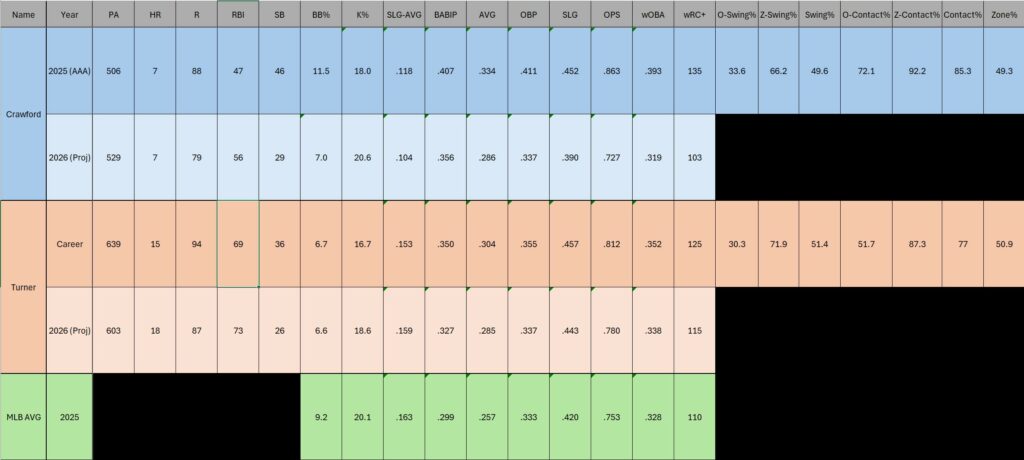
    Below is a table highlighting Crawford’s 2025 AAA data and his 2026 projections (via ZiPS) and comparing them to Turner’s and MLB averages from 2025.

    If the projections hold true, Crawford would provide the Phillies with more walks, stolen bases, average on balls in play and OBP.

    Turner’s greater power, evident in the disparity in OPS, could be better utilized protecting Harper or Schwarber, forcing pitchers to throw them more strikes.

    The best argument against Crawford leading off is that there would be three consecutive lefties at the top of the order: Crawford, Harper and Schwarber. Such a lineup would give opposing teams the opportunity to capitalize with their own left-handed pitchers.

    That argument is moot for two reasons. First, Crawford’s contact rates in the minors were consistent against both lefties and righties. In 2025, Crawfords platoon splits reflect the exact same OBP: .411.

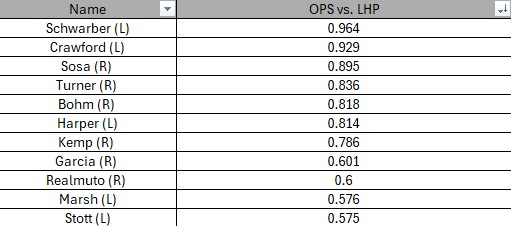
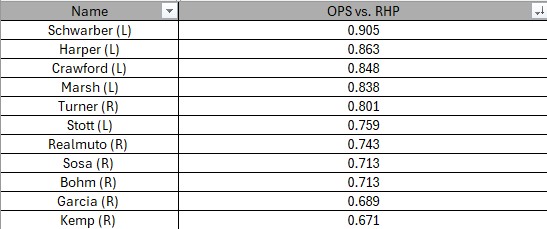
    Second, Schwarber and Harper crush lefties. In fact, Schwarber’s OPS was better in 2025 against lefties. He produced a .964 OPS against lefties compared to a .905 against righties.

    Crawford leading off lengthens the lineup significantly and also slots other batters into roles for which they are better suited.

    Bohm and Stott specifically see a drastic increase in OPS when they bat lower in the lineup. Stott is particularly at his best when batting ninth.

    The impact will not be felt on Opening Day. Crawford absolutely should not start his season at leadoff. Afterall, he is a rookie, and a leadoff role out of the gate would place unfair, and perhaps unrealistic, expectations on a player so young on a team with title aspirations.

    Yet Crawford has been poised, mature and above reproach so far. Perhaps the change the Phillies need is not too far down the road.

  • Framing the Farm: Gage Wood

    From first impressions, Gage Wood was born to be a Philadelphia Phillie.

    With the 26th overall pick in the 2025 MLB Draft, the Phillies selected Wood, a RHP from the University of Arkansas. Initially a reliever, Wood transitioned to a starting role, getting 13 starts in his college career.

    Wood was coming off a dominant Men’s College World Series (MCWS) performance, during which he threw just the third no-hitter in MCWS history.

    Wood threw 19 strikeouts in his epic no-hitter, providing a glimpse of his overpowering arsenal.

    Most pitchers would be ecstatic with the performance. Gage Wood was incensed by the one hit-by-pitch that kept him just short of perfection.

    For a city that rewards grinders with passion, Wood has the perfect attitude to play in the City of Brotherly Love. The question is: does he have the stuff?

    The short answer is unequivocally yes! He features a lively four-seam fastball and a power curve, both of which are already plus pitches that play beautifully off one another.

    He does throw a cutter/slider and, very rarely, a splitter. Both pitches need some work.

    His four seamer averages 94-96 mph, even occasionally touching 98 mph. The pitch’s movement induces plenty of swing and miss, producing a zone-whiff rate of 32% against righties and 46% against lefties (according to Sports Info Solutions).

    He couples the fastball with a devastating curve that already exceeds MLB averages in both velocity and break. It averages 83-85 mph and induces -16” of vertical break.

    Despite the impressive stuff, Wood is not a finished product. He needs to work on locating his fastball, limiting walks, and adding a pitch with arm-side movement.

    In an interview with Pitching Ninja (below; 17:58), Wood acknowledged the need to expand his arsenal. Such a pitch would keep lefties honest, limiting the success they have had against him. In 2025, lefties produced a .500 SLG%.

    So what would a successful season look like for Wood?

    Dave Dombrowski already alluded to the fact that the organization views Wood a candidate to fast-track to the big league club.

    An ambitious goal, but success for Wood this season would be closing in on a big league debut. That would mean he has improved control, remained healthy and limited damage from lefties.

    We will see how fast Wood can promote. For now, enjoy all his strikeouts from his 2025 MCWS performances.

  • A Big Market Team in a Mega Market World

    An unfortunate reality that the Phillies had to face this morning may be the new norm for professional baseball: teams cannot compete with the likes of the Dodgers and Mets, at least financially.

    The Phillies have wooed their big time free agents with long-term deals with high total value, suppressing average annual value to a manageable level. It is a formula that has worked. It landed them Bryce Harper and Trea Turner.

    Yet, the formula changed over the last 24 hours.

    Just last night Kyle Tucker signed a 4-year, $240 million contract with the Dodgers despite having more guaranteed money and years elsewhere. This morning, much to the dismay of Phillies fans, Bo Bichette chose a 3-year, $126 million contract with the Mets over the longer—and larger—deal with the Phillies.

    The two instances could be an aberration, or they could very well be a sign of a shifting culture in baseball, one in which only a few teams can play.

    The Phillies fancy themselves a big market team. Their projected 2026 tax payroll (including luxury tax) ranks third in baseball at $362 million, according to Spotrac. The Dodgers are first at $576 million, a difference of an astounding $214 million. The Phillies are closer to the twentieth-place Cincinnati Reds at $150 million than they are to the Dodgers. 

    According to reports, the Phillies met Bo Bichette’s 7-year, $200 million demand last night, only to wake up and see the news that  Bichette was headed to Queens. Suddenly, the Phillies’ trump card in free agent negotiations does not align with player priorities. Suddenly, the organization seems antiquated. Suddenly, the big market team shrinks against the mega market sport. Shorter deals, higher AAV, and the Phillies either cannot or will not adjust.

    It would be difficult to ignore the proliferation of opt-outs in contracts as a prequel to players prioritizing short term deals that expose them to market inflation, giving them the additional opportunities to cash in as payrolls continue to increase. 

    The Phillies do not grant opt-outs in their free agent contracts. General Manger Preston Mattingly said as much in an interview with the Baseball is Dead Podcast. Whether it is a hedge against their weak farm system to extract value by owning contracts that age into below-market value (see Bryce Harper) due to player overproduction or it is a cultural philosophy in team building, the Phillies’ hard stance against opt-outs indicate either a reluctance or inability to adapt to the contract climate. Likely, it is an inability to do so. The kind of financial investment continued market exposure and short terms contracts and opt-outs promoted is unsustainable for even the Phillies’ ownership group.

    The Phillies face a crossroads. Do they find a way to gain access to more funds, perhaps by adding additional owners? They’ve done it recently. Or do they admit they are a big market team in a mega market world and focus of revamping their farm system and operating like the Brewers, Rays, etc.? 

    The path forward may already be chosen for them.

  • Bohm Would Have to Go

    The Phillies will speak with Bo Bichette.

    Per Jon Heyman, the Phillies are set to conduct a video call with Bichette in the coming days to discuss a potential future in Philadelphia.

    Is a Bichette contract realistic? Likely not. The Phillies are wary of surpassing the 110% tax threshold, a threshold that any Bichette contract would far surpass. It’s fair to wonder if the Phillies are being used for leverage in the Bichette market, a market in which two massive market teams (the Blue Jays and the Dodgers) are heavily involved. However, it could be real.

    For a moment, let’s assume the smoke truly indicates a fire.

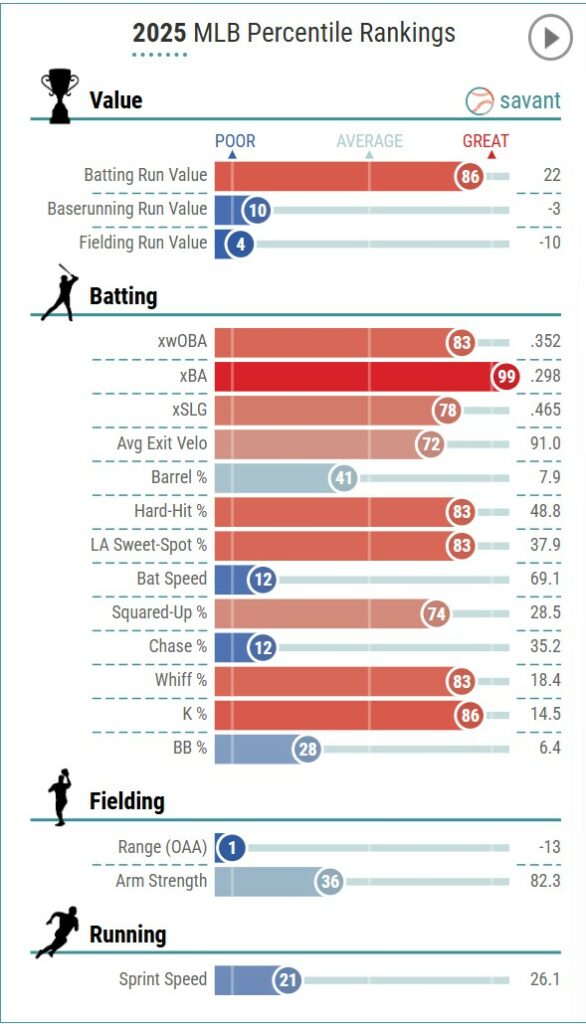
    The fit in the lineup is clear; he would immediately improve the Phillies cleanup spot. He’s right-handed, providing Harper with the protection the Phillies have desperately tried to find. When batting cleanup for the Blue Jays in 2025, Bichette slashed .372/.422/.585 in 180 plate appearances. His Baseball Savant page in enticing to say the least.

    The offensive benefit is obvious. The fit in the infield is much more nebulous.

    Last season, Bichette played shortstop for the Blue Jays. He was not particularly good. According to FanGraphs and Baseball Reference, Bichette posted -13 outs above average (OAA), -12 defensive runs saved (DRS), and -6 defensive wins above replacement(dWAR). All of those metrics were the worst among qualified shortstops. Even if he was an average defender at the position, the Phillies already employ Trea Turner, who scored, at minimum, above average in each of those metrics.

    Bichette has already indicated that he would be willing to play second base, a course of action that seems preferable to playing third. Bichette’s arm strength is well below average for a shortstop, making a switch to third out of the question. To fit the Phillies’ roster, Bichette would indeed need to make the change to second.

    That leaves two options; the Phillies would need to either trade Bryson Stott, or trade Alec Bohm and move Stott to third.

    The choice is clear.

    Today the Phillies agreed to terms with a few players in arbitration negotiations. Stott will earn $5.9 million while Bohm will earn $10.2 million. If the Phillies want to limit tax payments as much as possible for the 2026 season, trading Bohm minimizes tax payments more so than Stott. Critically, Stott remains cost-controlled through the end of the 2027 season via arbitration. Bohm is a free agent at the end of 2026. Keeping Stott gives the Phillies more financial flexibility both now and in the future.

    Offensively, retaining Stott gives the Phillies a more unique way of producing offense.

    Stott and Bohm ended the 2025 season with similar weighted on-base average numbers (wOBA)—.322 for Bohm compared to .315 for Stott—though their profiles suggest two very different ways of getting there. Stott’s patience at the plate and speed on the bases remains an asset to a team that sacrifices those skills in favor of power.

    Bohm served as Harper’s right-handed protection for most of the 2025 season, a job for which his production was insufficient. When batting cleanup, Bohm produced a .571 OPS in 107 plate appearances. With Bichette inheriting Bohm’s role as cleanup, the Phillies would benefit more from keeping Stott’s skillset at the bottom of the order rather than moving Bohm down.

    Notably, Stott changed his batting stance after the All-Star Break in 2025. After making the changes, Stott produced a .855 OPS. Projecting continued improvements in Stott’s offense is reasonable while Bohm’s production has continued to decline since his Homerun Derby appearance in 2024.

    Simply put, Stott offers the Phillies far more on offense.

    The concern lies primarily in projecting the impact of the defensive changes for the Phillies’ infield. They would be removing a gold glove-caliber second baseman in favor of Bichette, who would likely produce below average results while making relatively unknown changes at third.

    Stott did make his MLB debut at third, though he only played two games there before being sent back down. In the small sample size, Stott posted -1 defensive runs saved above average (Rdrs). Bohm has posted above 0 Rdrs only once—he posted 1 Rdrs in 2025—meaning that the Phillies may project a marginal drop in defensive performance at third.

    Still, the combined defensive changes are negligible when considering the positive impact of adding a bat of Bichette’s caliber. It is a gamble, but it is a gamble the Phillies need to make if they want to take advantage of their contention window.