The Phillies have been pretty straightforward with their messaging: two prospects that can/will make the big league club on Opening Day are Andrew Painter and Justin Crawford.
Crawford will be on the roster, presumably as the everyday center fielder. His performance defensively will be important, though not nearly as important as his offense.
Spring Training performance is not always indicative of the season a player will have; the results do not always matter. But the process leading to the result should, and the process leading to Crawford’s success in Clearwater is encouraging.
According to Fangraphs, Crawford has had 20 plate appearances in 5 games. He’s slashed .316/.350/.474, good for a 107 wRC+
Critically, it is his patience at the plate and his surprising pop that is most encouraging.
It has been an impressive start for Crawford in Clearwater. It may not always be the most pretty. There will be peaks, and there will be valleys. Development is not linear.
With that being said, Crawford’s production can unlock the Phillies’ offense.
It is no secret that the Phillies lack protection for Bryce Harper. That irrefutable fact has been a talking point for every reporter, journalist, podcaster and fan for most of the offseason.
Harper likes to bat third in the lineup. Topper likes to bat Schwarber in the first three to guarantee more at-bats across 162 games. If the Phillies swapped Schwarber and Harper, who then protects Schwarber?
It is a zero-sum game unless Trea Turner bats cleanup. Who then bats first?
The answer could be Justin Crawford.
Crawford’s two best traits are his OBP and his base running value. The biggest question in his game is his groundball rate and its propensity to cause GIDP opportunities.
By leading off, the Phillies would take full advantage of Crawford’s best traits and mitigate the impact of his worst.
Below is a table highlighting Crawford’s 2025 AAA data and his 2026 projections (via ZiPS) and comparing them to Turner’s and MLB averages from 2025.
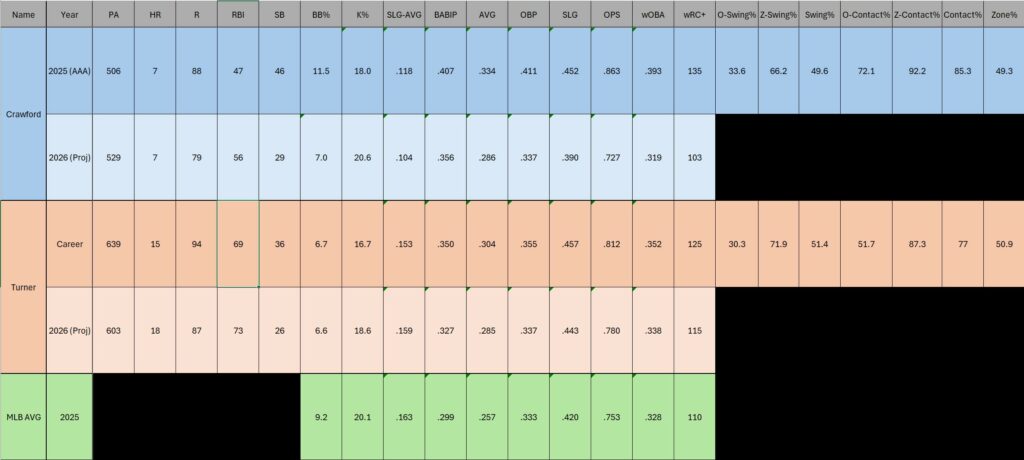
If the projections hold true, Crawford would provide the Phillies with more walks, stolen bases, average on balls in play and OBP.
Turner’s greater power, evident in the disparity in OPS, could be better utilized protecting Harper or Schwarber, forcing pitchers to throw them more strikes.
The best argument against Crawford leading off is that there would be three consecutive lefties at the top of the order: Crawford, Harper and Schwarber. Such a lineup would give opposing teams the opportunity to capitalize with their own left-handed pitchers.
That argument is moot for two reasons. First, Crawford’s contact rates in the minors were consistent against both lefties and righties. In 2025, Crawfords platoon splits reflect the exact same OBP: .411.
Second, Schwarber and Harper crush lefties. In fact, Schwarber’s OPS was better in 2025 against lefties. He produced a .964 OPS against lefties compared to a .905 against righties.
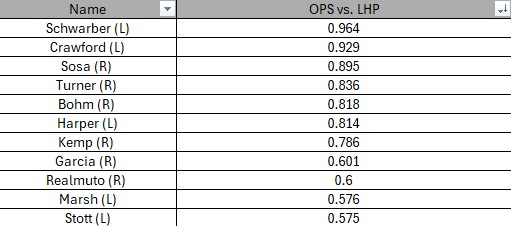
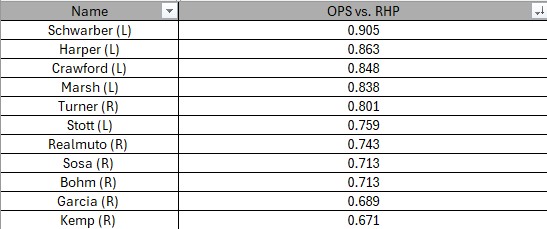
Crawford leading off lengthens the lineup significantly and also slots other batters into roles for which they are better suited.
Bohm and Stott specifically see a drastic increase in OPS when they bat lower in the lineup. Stott is particularly at his best when batting ninth.
The impact will not be felt on Opening Day. Crawford absolutely should not start his season at leadoff. Afterall, he is a rookie, and a leadoff role out of the gate would place unfair, and perhaps unrealistic, expectations on a player so young on a team with title aspirations.
Yet Crawford has been poised, mature and above reproach so far. Perhaps the change the Phillies need is not too far down the road.
Leave a Reply