I find the Eagles’ ongoing offensive coordinator search to be a fascinating study on the assumption of risk and the results of those assumptions both for the Eagles and for their candidates.
My boss at my last job always spoke of “the assumption of risk.” By choosing one course of action, we open ourselves up to the consequences of that decision. By choosing another, we invite different results, both positive and negative. It’s incumbent on the decision-makers to weigh those courses of action and make the best decision possible, accepting the negative results when they occur. We’ve done the homework, we’ve made the assessment, we’ve mitigated (as much as we can) the negative results, and now we deal with those consequences. It’s a model everyone uses to some degree both in their workplace and in their personal lives.
The Eagles now find themselves facing the results of their decisions.
The Eagles front office has not been shy about quickly moving on from coaches that compromise their contention windows, even when those coaches are accomplished. Sean Desai, Matt Patricia, Brian Johnson, and now Kevin Patullo, are not examples of accomplished coaches per se. Each had their flaws, but they also presided over teams that won 11+ games in a season. Doug Pederson and Press Taylor, while fired after a 4-win season, had just won the Eagles’ first Super Bowl only three seasons prior. Accomplished, to say the least.
The Eagles’ were not necessarily wrong in firing said coaches. The defense in 2023 was abysmal. Pederson and Taylor’s offenses were stale. We know how bad Patullo’s offense fared just one season after winning a Super Bowl; the realized impact still fresh in our minds. The Eagles have had success in the short-term by making such moves. After firing Pederson and Taylor, the Eagles were in a Super Bowl only two seasons later. They won their second Super Bowl just one season after parting ways with Desai, Patricia and Johnson. But the long-term risk of firing coaches after winning seasons or so quickly after winning Super Bowls was always discouraging future hires with perceived instability of the position. That perception is not wrong, and now it has finally affected their coordinator search.
“What is the standard for success?” “How long will that standard apply?” “Can I assume that the Eagles will still employ me after a single bad season?” “Is the job worth it?” These are all fair questions invited by the Eagles’ aggression in pursuing a championship window at the expense of finding coaches that align with the organization’s vision and priorities, and parting ways with those that do not.
The assumption of risk is not one-sided. For the candidates, the assumption of risk lies in their comfortability with Nick Sirianni’s control of the offense affecting their future head coaching viability. There is already most of a staff in place. Stoutland has survived numerous coaching regimes, and that is not likely to change. No one truly knows how much input Sirianni has in game plans, though it’s safe to say coordinators do not have complete independence. But the offense remains one of the most talented in football. The ceiling is a top-5 player or unit at every position on the field.
There is high risk that results in relief less than one year after being hired, whether it real or only perceived. High reward in a fast track to a head coaching job elsewhere (see Kellen Moore and Shane Steichen). It is no coincidence that Moore was a head coach candidiate for years, did not get the jobs he wanted, then immediately earned one after a single year of being the Eagles’ offensive coordinator. If a candidate wants the payoff of being a head coach somewhere but lacks the resume, the Eagles job provides a quick and clear path to that end.
The Eagles should still be able to hire an offensive coordinator that can take the Eagles’ offense back to a Super Bowl-caliber unit, though it likely will not come in the way fans may have imagined. The front office’s gamble, and the risk involved with that gamble, intersects with the coaching candidacy in a unique way that optimizes the selection for a particular type of coordinator: young innovators with a point to prove.
The Eagles offensive coordinator job should still be attractive to a bunch of candidates. Maybe not the ilk they want: an established, experienced and well-respected play caller like Kevin Stefanski or Mike McDaniel. There is no reason for coaches like that to assume the risk presented to them in Philadelphia. But it should still attract a subset of young, hungry and creative minds that want to fast track themselves to a head coaching gig. They shouldn’t settle for a retread. There are young and ambitious brains out there that would love the opportunity to catapult their name into the next coaching carousel. The Eagles should take their time in finding the perfect one.
An unfortunate reality that the Phillies had to face this morning may be the new norm for professional baseball: teams cannot compete with the likes of the Dodgers and Mets, at least financially.
The Phillies have wooed their big time free agents with long-term deals with high total value, suppressing average annual value to a manageable level. It is a formula that has worked. It landed them Bryce Harper and Trea Turner.
Yet, the formula changed over the last 24 hours.
Just last night Kyle Tucker signed a 4-year, $240 million contract with the Dodgers despite having more guaranteed money and years elsewhere. This morning, much to the dismay of Phillies fans, Bo Bichette chose a 3-year, $126 million contract with the Mets over the longer—and larger—deal with the Phillies.
The two instances could be an aberration, or they could very well be a sign of a shifting culture in baseball, one in which only a few teams can play.
The Phillies fancy themselves a big market team. Their projected 2026 tax payroll (including luxury tax) ranks third in baseball at $362 million, according to Spotrac. The Dodgers are first at $576 million, a difference of an astounding $214 million. The Phillies are closer to the twentieth-place Cincinnati Reds at $150 million than they are to the Dodgers.
According to reports, the Phillies met Bo Bichette’s 7-year, $200 million demand last night, only to wake up and see the news that Bichette was headed to Queens. Suddenly, the Phillies’ trump card in free agent negotiations does not align with player priorities. Suddenly, the organization seems antiquated. Suddenly, the big market team shrinks against the mega market sport. Shorter deals, higher AAV, and the Phillies either cannot or will not adjust.
It would be difficult to ignore the proliferation of opt-outs in contracts as a prequel to players prioritizing short term deals that expose them to market inflation, giving them the additional opportunities to cash in as payrolls continue to increase.
The Phillies do not grant opt-outs in their free agent contracts. General Manger Preston Mattingly said as much in an interview with the Baseball is Dead Podcast. Whether it is a hedge against their weak farm system to extract value by owning contracts that age into below-market value (see Bryce Harper) due to player overproduction or it is a cultural philosophy in team building, the Phillies’ hard stance against opt-outs indicate either a reluctance or inability to adapt to the contract climate. Likely, it is an inability to do so. The kind of financial investment continued market exposure and short terms contracts and opt-outs promoted is unsustainable for even the Phillies’ ownership group.
The Phillies face a crossroads. Do they find a way to gain access to more funds, perhaps by adding additional owners? They’ve done it recently. Or do they admit they are a big market team in a mega market world and focus of revamping their farm system and operating like the Brewers, Rays, etc.?
Per Jon Heyman, the Phillies are set to conduct a video call with Bichette in the coming days to discuss a potential future in Philadelphia.
Is a Bichette contract realistic? Likely not. The Phillies are wary of surpassing the 110% tax threshold, a threshold that any Bichette contract would far surpass. It’s fair to wonder if the Phillies are being used for leverage in the Bichette market, a market in which two massive market teams (the Blue Jays and the Dodgers) are heavily involved. However, it could be real.
For a moment, let’s assume the smoke truly indicates a fire.
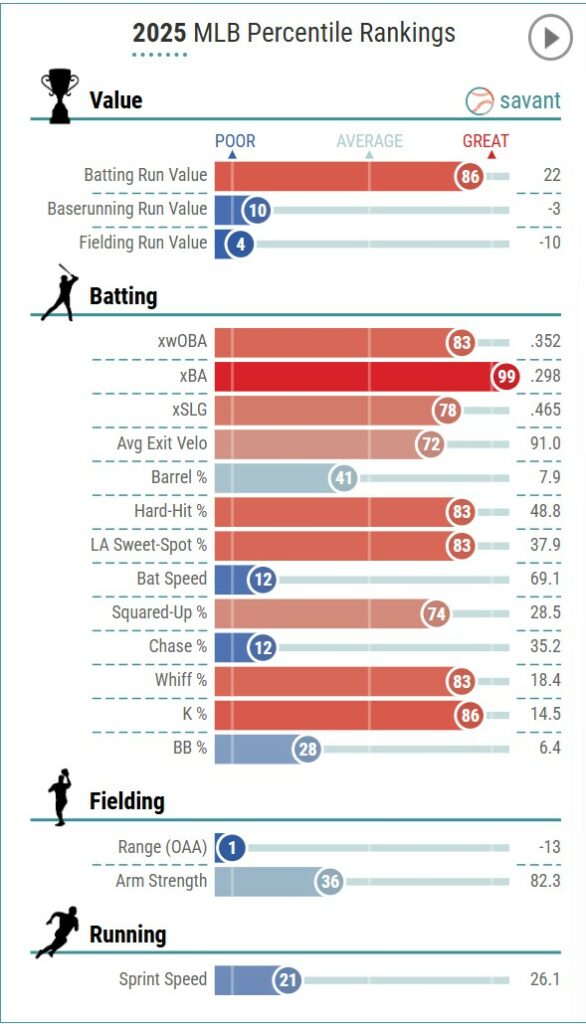
The fit in the lineup is clear; he would immediately improve the Phillies cleanup spot. He’s right-handed, providing Harper with the protection the Phillies have desperately tried to find. When batting cleanup for the Blue Jays in 2025, Bichette slashed .372/.422/.585 in 180 plate appearances. His Baseball Savant page in enticing to say the least.
The offensive benefit is obvious. The fit in the infield is much more nebulous.
Last season, Bichette played shortstop for the Blue Jays. He was not particularly good. According to FanGraphs and Baseball Reference, Bichette posted -13 outs above average (OAA), -12 defensive runs saved (DRS), and -6 defensive wins above replacement(dWAR). All of those metrics were the worst among qualified shortstops. Even if he was an average defender at the position, the Phillies already employ Trea Turner, who scored, at minimum, above average in each of those metrics.
Bichette has already indicated that he would be willing to play second base, a course of action that seems preferable to playing third. Bichette’s arm strength is well below average for a shortstop, making a switch to third out of the question. To fit the Phillies’ roster, Bichette would indeed need to make the change to second.
That leaves two options; the Phillies would need to either trade Bryson Stott, or trade Alec Bohm and move Stott to third.
The choice is clear.
Today the Phillies agreed to terms with a few players in arbitration negotiations. Stott will earn $5.9 million while Bohm will earn $10.2 million. If the Phillies want to limit tax payments as much as possible for the 2026 season, trading Bohm minimizes tax payments more so than Stott. Critically, Stott remains cost-controlled through the end of the 2027 season via arbitration. Bohm is a free agent at the end of 2026. Keeping Stott gives the Phillies more financial flexibility both now and in the future.
Offensively, retaining Stott gives the Phillies a more unique way of producing offense.
Stott and Bohm ended the 2025 season with similar weighted on-base average numbers (wOBA)—.322 for Bohm compared to .315 for Stott—though their profiles suggest two very different ways of getting there. Stott’s patience at the plate and speed on the bases remains an asset to a team that sacrifices those skills in favor of power.
Bohm served as Harper’s right-handed protection for most of the 2025 season, a job for which his production was insufficient. When batting cleanup, Bohm produced a .571 OPS in 107 plate appearances. With Bichette inheriting Bohm’s role as cleanup, the Phillies would benefit more from keeping Stott’s skillset at the bottom of the order rather than moving Bohm down.
Notably, Stott changed his batting stance after the All-Star Break in 2025. After making the changes, Stott produced a .855 OPS. Projecting continued improvements in Stott’s offense is reasonable while Bohm’s production has continued to decline since his Homerun Derby appearance in 2024.
Simply put, Stott offers the Phillies far more on offense.
The concern lies primarily in projecting the impact of the defensive changes for the Phillies’ infield. They would be removing a gold glove-caliber second baseman in favor of Bichette, who would likely produce below average results while making relatively unknown changes at third.
Stott did make his MLB debut at third, though he only played two games there before being sent back down. In the small sample size, Stott posted -1 defensive runs saved above average (Rdrs). Bohm has posted above 0 Rdrs only once—he posted 1 Rdrs in 2025—meaning that the Phillies may project a marginal drop in defensive performance at third.
Still, the combined defensive changes are negligible when considering the positive impact of adding a bat of Bichette’s caliber. It is a gamble, but it is a gamble the Phillies need to make if they want to take advantage of their contention window.
“Kawhi up top. Looks at the clock. Turns the corner! For the win! Kawhi Leonard with the game winner!”
With 4.2 seconds left in Game 7 of the 2019 Eastern Conference Semifinals, Kawhi Leonard carried the ball around the top of the key, ran to the corner, and hit a buzzer beater to defeat the Philadelphia 76ers in the 2019 Eastern Conference Semifinals. The ball had bounced around the rim for what seemed like an eternity before ending the Sixers’ season.
The crowd in Toronto erupted into a roaring celebration of the miraculous shot, a stark contrast from Sixers fans.
Deafening silence.
A collective and overwhelming sense of stunned disappointment befell the city of Philadelphia, such that no one even moved. It was as if a hivemind controlled all Sixers fans and told them not to react beyond a singular denial of what had just transpired.
“I was at Kelly’s bar in Villanova,” said Pete Crossan, a Downingtown native and Sixers fanatic. “The whole bar froze. No one spoke. The sound wasn’t even disbelief at first, it was that hollow kind of silence that only happens when hope collapses all at once.”
In hindsight, it ended more than just a season. It ended an era and a revolution.
Sixers fans are no strangers to a loss. They had, after all, gotten to this point on a resumé rife with losses. “The Process,” the theory that the Sixers could escape a future of mediocrity, encouraged losing at its very core.
But this one felt different. It shattered resolve.
“When that shot bounced around the rim and fell in, the hope was gone. The emotional investment, the belief that maybe next year would finally be the one, it all bounced away with that shot,” said Crossan.
It finally broke a fanbase that had thought itself unbreakable.
____________________________________________
The Process
Sam Hinkie is somewhat of a folk hero in Philadelphia, sparking a shift in basketball culture in the city. His radical ideas garnered immense support from the team’s fans and utter disdain from the wider NBA audience, a type of villainy that the city so proudly embraced.
He arrived in Philadelphia in May 2013 in the midst of stagnation. The Sixers were not quite contenders for a Finals appearance, nor were they bad enough to draft franchise-altering players. They were in the NBA’s “No Man’s Land.”
The task at hand for Hinkie was daunting: take a roster devoid of top-end talent and transform it into a perennial championship contender.
His plan was simple to understand but not simple to sell. Professional sports franchises and their fans typically want to win. The Sixers were going to lose, and they were going to lose a lot.
Hinkie proposed a radical idea to lose on purpose. In 2013, a publicly acknowledged tank, especially at the magnitude and length Hinkie proposed, was unheard-of.
“It’s easy to forget how radical The Process was at the time,” said Crossan. “Losing on purpose, stockpiling picks, rejecting ‘win now’ pressure…it flew in the face of everything the league wanted in terms of competitiveness and marketability.”
By losing as much as they could, the Sixers would inherit the opportunity to draft players high in the lottery. In conjunction, the Sixers were going to trade their good players to accrue additional picks to either select more developmental players or to package in future trades for stars. The idea was built on probabilities, statistical analysis of the likelihood that a pick would convey, a player would develop, or a season would end with a Larry O’Brien trophy.
The question was if the Sixers and their fans had the stomach to endure consistent ridicule and doubt. What happens when your favorite team is reduced to a probability experiment? Especially in a “basketball city?”
At the outset, it was a proudly defiant revolution against the NBA for a team named aptly after a revolution itself. But the Sixers’ experiment was called “The Process,” not “The Result.”
The results are bleak.
“For years after the Allen Iverson era ended, the Sixers were within range of the playoffs, or in by a hair as a 7th or 8th seed, but never a serious challenge. They were stuck in purgatory. Good enough to hang around and get a first round’s worth of playoff revenue, never really relevant in a meaningful way,” wrote CBS’ Matt Moore in 2016 during a reflection on Hinkie’s tenure with the Sixers.
The Sixers remain right where they began.
During Hinkie’s tenure from 2013-2016, the Sixers posted a paltry record of 47-195. The losses were expected but so was playoff success, at least down the road.
But what playoff success do Sixers fans have to show for their commitment to an era of sustained losing?
Their deepest playoff run remains an ill-fated triple bounce in Game 7 against Kawhi Leonard’s Raptors in the 2019 Eastern Conference Semifinals.
In terms of stockpiling picks to increase the probability of finding a superstar, the Sixers improbably squandered their chances. The Sixers acquired two separate first overall selections in the NBA draft and walked away with Ben Simmons and Markelle Fultz. Fultz now plays for the Sacramento Kings, his third team since entering the league, and boasts a career-best point per game mark of 14.0.
Simmons no longer plays professional basketball.
Where the Sixers failed in finding talent through the draft, they did not make up via trade or free agency. Former Sixer Jrue Holiday won a championship with the Sixers’ greatest rival, the Boston Celtics. Fan favorite, TJ McConnell, was one game short of winning a Finals MVP for the Indiana Pacers.
Instead, the Sixers chose failed relationships with James Harden, Jimmy Butler, Tobias Harris and Al Horford, all while wasting the prime of their lone superstar’s career, Joel Embiid.
An abject disaster.
The Process’ course towards failure hinged on a few seminal moments, moments that crushed a city and ultimately defined a legacy of failure.
____________________________________________
A Sacrificial Lamb
Sixers fans bought into the idea of The Process. For a team that planned to lose so much, it was the promise of a dominant future that kept fans aligned with The Process’, well, process.
Sixers’ ownership had actually considered hiring Sam Hinkie a season before they ended up doing so. As Pablo Torre reported for ESPN in 2015, Sixers’ owners Josh Harris and David Blizter had previously been impressed with Sam Hinkie’s ideas. “As a veteran of finance, [Hinkie] was fluent in the dispassionate language of expected value and probability,” Torre wrote. “Hinkie believed, as Harris and Blitzer did, that the process leading to a decision should matter more than the result.”
For as much as the owners were impressed by Hinkie’s beliefs, there was a lingering problem that had kept them from hiring Hinkie a season earlier. “As much as they were charmed by Hinkie’s abstract ideas, they couldn’t help but think skeptically,” Torre wrote. Their skepticism remained throughout Hinkie’s years at the helm.
The Process performed well. The Sixers amassed an incredible amount of draft capital and assets to set The Process up for success. In a letter to the owners of the Sixers in 2016, Hinkie pointed out that within the Sixers’ first 26 months of The Process, they added more than one draft pick or pick swap per month. Additionally, they received some of the best draft lottery luck in the history of the NBA.
Shockingly, fans remained positive about the progress The Process was making, especially the younger Sixers fans.
“Younger fans were much more supportive,” said Mike Sielski, a columnist for the Philadelphia Inquirer who’s covered the Sixers for more than a decade. “This is proving truer the further away from The Process we get. The bitterness that most Philadelphia fans felt really before Eagles won the Super Bowl comes from the Phillies collapse in 1993. That moment scarred fans for years. The baby boomers and Gen Xers became very bitter and skeptical about everything. They are inclined and conditioned to say that this sucks, everything sucks. Younger fans had experienced the Phillies winning the NL East, the World Series, and the Eagles winning the Super Bowl. Social media made it more acceptable to be an optimistic fan.”
But the successful set up for The Process and positive momentum was not enough to save Hinkie from the hands of the NBA and the lack of commitment from the Sixers’ ownership group.
If they had known, fans may have anticipated the coming coup d’état.
On Dec. 6, 2015 the Sixers hired long-time NBA executive Jerry Colangelo as the Chairman of Basketball Operations, a position that oversaw General Manager duties.
ESPN reported the decision to hire Colangelo came when Josh Harris “wanted more than an opinion on what was wrong with his failing franchise.” Harris wanted Colangelo to “fix and save the Sixers as part of the front office.”
Not wanting to be held hostage during his process, Hinkie resigned as General Manager just four months later, on April 6, 2016.
Hinkie wrote a 13-page resignation letter. In it, he raved about the potential future of the Sixers, of what The Process had accomplished in just three years. Specifically, he cited the draft capital amassed over the course of The Process, the franchise’s growing international pipeline, and most importantly, the potential of the crown-jewel of The Process, Joel Embiid.
The letter cemented Hinkie’s folk hero status in Philadelphia. Fans, rightfully, were distraught by his unexpected departure.
“I think part of the loss of faith in The Process came from how the organization handled Sam Hinkie,” Crossan said. “Fans were still bought in, even through the losing, because there was a plan. But when ownership forced Hinkie out and brought the Colangelos, it was a clear sign that they didn’t believe anymore. The front office lost its nerve before the fans did.”
Amateur Philadelphia sports blogger and podcast host Mitchell Warner did not think the Colangelo hire and Hinkie resignation was just the franchise’s decision.
“We never got to follow through with The Process as a team building idea,” he said. “It was chopped off at the knees when the organization fired Hinkie. They forced the Colangelos on us as a punishment for The Process.”
If the hiring of Colangelo was in fact a punishment for The Process, it was damning. Because Hinkie was not able to see The Process to its completion, it was doomed to failure.
“Embiid was the only truly great player they got,” said Sielski.
Crossan believes it was the change from Hinkie to Colangelo that signaled the end of The Process’ core tenets.
“The second Colangelo took over, you saw the shift. Win sooner, get star names, speed it all up. And that’s when the cracks started to show,” he said.
____________________________________________
Nepotwitterism
Sixers fans’ skepticism surrounding Jerry Colangelo was met almost immediately with justification of their fears.
Just after Jerry Colangelo usurped Sam Hinkie at the helm of The Process, ESPN Insider Brian Windhorst reported that owners across the NBA had “been lobbying the league’s front office to step in with regard to the direction” that the Sixers were taking. Windhorst further reported that “NBA commissioner Adam Silver was instrumental in forming the partnership between Colangelo and 76ers owner Joshua Harris.”
In the minds of Philadelphians, the correlation between Jerry Colangelo and intentional franchise sabotage was strong.
“The NBA stepping in and essentially installing Bryan Colangelo felt like outside interference into something organic,” said Crossan.
A sham General Manager search did not help assuage Philadelphia’s suspicions. After Hinkie resigned, Jerry Colangelo led a “search” to fill Hinkie’s empty General Manager role. After conducting a reportedly thorough search, Jerry Colangelo finally settled on hiring Bryan Colangelo, his son.
Bryan Colangelo’s time as the Sixers’ General Manager had some ups, but mostly downs. Among his most notable shortfalls was his inability to draft stars, despite having two attempts to do so with the first overall pick in the NBA Draft.
During the 2016 NBA draft, Bryan Colangelo drafted Ben Simmons first overall. Notably, Bryan Colangelo could have selected Jaylen Brown, Jamal Murray or Pascal Siakam, all of whom have since won a championship with the team that drafted them. Simmons’ failure to develop as a shooter would later cost the franchise dearly.
Just one year later, Bryan Colangelo made a trade with the rival Boston Celtics to move up to the first overall pick. This time, Colangelo selected Washington guard Markelle Fultz. Colangelo passed on the opportunity to draft Jayson Tatum, Lauri Markkanen, Donovan Mitchell and OG Anunoby in favor of Fultz, who suffered thoracic outlet syndrome. The rare injury deteriorated Fultz’s shooting form, from which he never recovered and was eventually traded to the Orlando Magic.
Yet, for all of his shortfalls as a team builder, Bryan Colangelo’s biggest failure was the toxic culture that he fostered in the locker room, evident in one of the most bizarre scandals in NBA history.
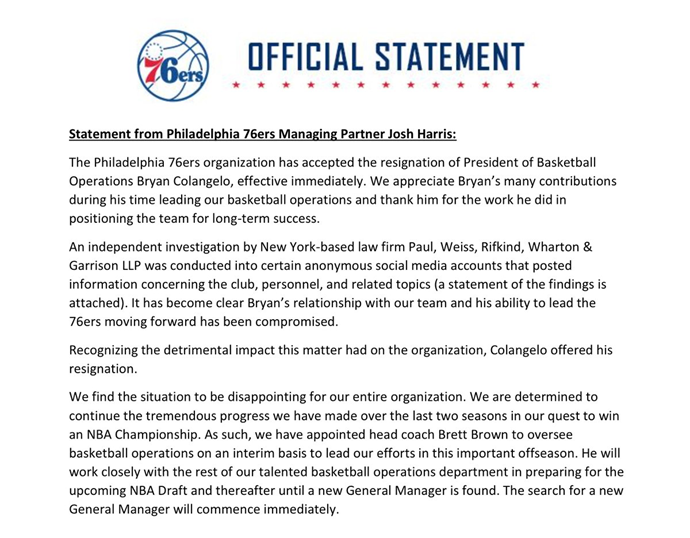
On May 29, 2018, the Ringer’s Ben Detrick reported that an anonymous source informed him that Bryan Colangelo was using burner Twitter accounts, leaking sensitive information and making disparaging comments about Sixers players and other General Managers in the NBA.
Detrick reported that for all of the Sixers’ improvements during the 2017-2018 season, the burner Twitter accounts “anonymously [sparred] with the media and [defended] Colangelo’s reputation” as well as “tipped team strategy.” Detrick claimed that “together, these acts, if true, could be severely damaging to Colangelo’s organization and amount to a huge breach of trust between him and the people he oversees.”
Detrick reported that one of the burner accounts “liked a tweet that advocated sending the No. 3 pick and the 2018 Lakers pick to Boston for the top selection, but without including Dario Saric. If rival teams were aware of this account, it had publicly broadcast the Sixers’ strategy a full month before the NBA draft.”
Not only did the burner accounts potentially leak team strategy and breach the trust of the organization and its players, it also raised the alarm for fans of The Process, who saw the scandal as another critical indicator of a failing franchise whose direction was changing for the worse.
To fans, it reinforced their fear of a NBA league office out to destroy their process.
“I think he was sent to us with the knowledge that he was going to be bad at the job of rebuilding the Sixers. Or at least kind of bad. The league has always been against The Process,” said Warner.
As with any scandal, the organization scrambled to find and disseminate answers. Sixers ownership hired a private firm to investigate if the accounts were, in fact, Bryan Colangelo’s. The firm found that the accounts were Bryan Colangelo’s wife’s.
Whether the accounts were Bryan Colangelo’s or his wife’s, the relationship between the Sixers front office, the players and the fans was dealt a critical blow.
The dysfunction between players, coaches, the front office and owners exposed in the tweets was an indictment on ownership and pointed to organizational failures.
The Process was failing.
____________________________________________
Passing By
“These Sixers are conspicuously long-limbed…approximately none of them can, you know, shoot. This is no accident. It remains scientifically impossible to develop arm length, an underrated characteristic on defense. (‘Sam is very studied in regards to that,’ Brown says.) But as Spurs wing Kawhi Leonard has verified, it is possible to grow a prospect’s shooting ability over time. And Philly, forcing turnovers at a league-high 15.6 percent through the All-Star break but shooting a league-low 41 percent, is incentivized to wait on such a large-scale renovation.”
Pablo Torre’s article on Hinkie’s philosophy references Hinkie’s team-building principle to gamble on length over shooting ability.
It is a gamble that did not bear a strong return on investment.
Perhaps the most glaring example of the fault in this principle is Ben Simmons.
Every summer, the Sixers promised Ben Simmons development. Every summer, Sixers fans heard about his expanded game. Every summer, Sixers fans flocked to grainy footage of Ben Simmons’ jump shot in summer shootarounds.
Yet after every summer, when the games actually mattered, Simmons did not deliver.
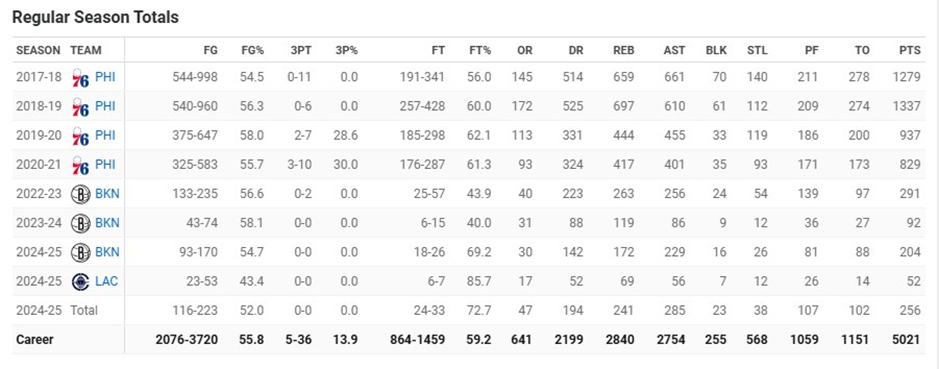
Over the course of his Sixers career, Simmons shot 5-34 from three, good for a 14.7 shooting percentage.
Simmons shot 809-1,354 on free throws, a putrid 59.75 free throw percentage.
Instead of improving, Simmons actually got worse each season after his 2017-2018 Rookie of the Year campaign. A player that once displayed so much promise collapsed.
Following the Sixers loss to the Raptors in the 2019 Eastern Conference Semifinals, the Sixers had a decision to make between Simmons and Jimmy Butler.
The Sixers acquired Butler around the trade deadline to help them in a championship run. They sent Process legends Robert Covington and Dario Saric to Minnesota in the trade. Butler performed well in Philadelphia and built a rapport with franchise-cornerstone Joel Embiid. Butler even almost saved the Sixers season against the Kawhi Leonard’s Raptors. He drove the lane and tied the game at 90 with 4.2 seconds left before Kawhi Leonard’s infamous shot.
Yet, rumors circulated that Simmons was unhappy with his role with Butler in the offense. Butler often controlled the ball on the court, relegating Simmons to a more passive role that Simmons did not prefer.
The Sixers acquiesced Simmons request and gave him a massive extension rather than keep Butler.
The Sixers traded Butler to the Miami Heat, who made two Finals appearances with Butler as their best player. He was lionized for his playoff performances.
Simmons, on the other hand, became infamous in Philadelphia lore for another seminal moment in the failure of The Process.
During the 2020-2021 season, the Sixers earned the 1-seed in the Eastern Conference. After defeating the Washinton Wizards in the first round of the Eastern Conference playoffs, the Sixers faced the 5-seed Atlanta Hawks.
The Sixers immediately squandered their home court advantage by losing Game 1 of the series.
The series went back-and-forth, forcing Game 7 at the Wells Fargo Center in Philadelphia. Throughout the series, Simmons struggled offensively. Critically, he was struggling mightily at the free throw line. The Hawks resorted to intentionally fouling Simmons when he had the ball, expecting him to miss at least one of his free throws.
With the Sixers down 88-86 in the 4th Quarter of Game 7, Simmons received a pass directly under the basket with only the 6-foot-1 Trae Young in front of him. For a player of Simmons’ caliber, strength and size, the wide open dunk should have been an emphatic slam that generated unstoppable momentum and shattered the Hawks’ resolve.
Instead, fearing he would be fouled and have to go to the free throw line (likely for a chance at a 3-point play), Simmons passed to an unexpecting Matisse Thybulle who missed the layup.
Simmons never mentally recovered from the 2021 Hawks playoff series, continuing to regress. The following season, the Sixers traded Simmons to the Brooklyn Nets. The Sixers’ prioritizing Simmons over Butler is an indictment on the Sixers’ organizational missteps.
Sielski points to the Simmons selection during the 2016 NBA Draft as further evidence of Sixers’ failing organization.
“[That is an] organizational [failure],” Sielski said. “I recently wrote a story about Ace Bailey and Dylan Harper. How good could Ace Bailey and Dylan Harper be? They are supposedly generational level talents but they couldn’t make the NCAA tournament? They should have seen that with Fultz and Simmons. How great can this kid be if his team is 9-22?”
The moment Simmons passed up a dunk over a 6-foot-1 guard, Sixers fans got the message: the Sixers’ franchise-altering players may not be the stars they wanted.
____________________________________________
The Final Nail
Video Credit: Did the Sixers Win?
Celtics-Sixers, an age-old rivalry.
This time, the showdown came during the 2023 NBA Playoffs. The Sixers were the 3-seed in the East and had just beaten the Toronto Raptors.
Sixers fans saw the Raptors series as a chance at retribution for the 2019 Eastern Conference Semifinals, when Kawhi Leonard sent the Sixers home on his miracle shot.
The Sixers had in front of them the opportunity to justify all the missteps during The Process by finally beating Boston in the playoffs.
The Celtics had the Sixers’ number. Boston had sent the Sixers home in both the 2018 and 2020 playoffs and had also claimed the majority of regular season matchups during The Process era. Joel Embiid even claimed in 2018, “this is not a rivalry…they always kick our ass.”
Not exactly the most inspiring words from the crown-jewel of The Process.
Surely, this time would be different. This time, the Sixers had surrounded Embiid with complementary pieces: guards that could shoot. Embiid was on his way to his first MVP honor. Despite all of The Process’ failures that preceded this series, there was still a small bit of hope among fans that Tyrese Maxey and James Harden could be the final pieces. This time, the Sixers had a chance.
Yet, nothing changed.
In fact, the series was the final nail in The Process’ haphazardly created coffin.
Sielski points to the series as the moment he knew that The Process era was over and that it was going to end in failure: “The moment I think of was Game 5 of the Eastern Conference Seminfinals in 2023. [The Sixers] go to Boston and they end up beating the Celtics. Embiid had a chase down block. It was an incredible defensive play. This is what everyone had been waiting for. Two nights later in Wells Fargo, they just don’t show up. It was the night that Embiid got the MVP award.”
Video Credit: Always Hoops
The Sixers had a chance to reverse the results of The Process. All of the failures that accompanied Sam Hinkie’s doomed team building philosophy could have all been forgotten. They won Game 5 in Boston on the back of Embiid’s greatness. It was his time to shed the label as a playoff disappearing act. He was the MVP, the best player in the world. They were up 3-2 in the series with the opportunity to close it out at home in the Wells Fargo Center.
They were even leading at the start of the 4th Quarter of Game 6. Instead of rising to the moment, the Sixers shrank and Jayson Tatum powered the Celtics to victory behind a 16-point 4th Quarter.
The Sixers barely got off the bus for Game 7 in Boston, losing 112-88.
The series surrender was indeed the death stroke for Sixers fans, who had already broken after Kawhi Leonard’s shot in 2019. More than anger, fans felt numb, the sign of a disassociated fanbase.
Losing to the rival Celtics in such an embarrassing way was a message that this Sixers team, built through The Process, was a team and culture built on failure. Sielski summarized it best: “You have to get the right athlete to establish a culture,” he said. “The Spurs established their culture with David Robinson and Tim Duncan. The Warriors had Curry. The Sixers didn’t have that guy, and it’s rare to have one. If they erred in culture, it was that they didn’t bring in a vet to guide Joel. The difference between Embiid and LeBron or Curry or Duncan is that those guys will slit your throat and drink your blood to win. I don’t think Embiid ever developed that.”
The Process was officially dead, as were the hopes of an entire city.
____________________________________________
Fin
Apathy and disassociation, that is the legacy of The Process, cemented by Kawhi Leonard in 2019 and confirmed after each failure since.
“For me, The Process died the night Kawhi Leonard hit the miracle buzzer-beater,” said Warner. “That shot didn’t just end a playoff run, it ended the era. We had a real shot at the Finals that year, and everything seemed to finally be coming together. When the ball bounced four times and fell in, it felt like the basketball gods were telling Philly fans, ‘this isn’t your year, and maybe it never will be.’ After that, I still root for the Sixers, but not with the same intensity. I’ve become more of a casual fan. The emotional investment just doesn’t feel worth it anymore.”
The shot defined The Process in just 4.2 seconds: failure by the narrowest of margins in a process designed to maximize them.
Over a decade—from May 2013 when Sam Hinkie came to Philadelphia until 2023 when the Sixers returned to Philadelphia after their Game 7 embarrassment in Boston—those margins begin to accumulate.
From another lens, The Process was an exercise in futility, a theory enacted to escape the NBA’s No Man’s Land that resulted in a brief escape and expeditious return. Asked if the team is right back where it started, Sielski answered succinctly: “Yes. It is.”
If the Sixers returned right back to where they started, was it worth it? Was the resulting heartbreak followed by apathy worth it?
Crossan’s answer is nuanced: “Looking back, I don’t regret The Process,” he said. “It gave us Joel. It gave us hope. And it gave us a shot at something bigger than being a 7-seed every year. But would I buy into it again? Knowing how it all played out? Probably not. Because now we know how fragile that kind of long-term gamble can be. You need more talent. You need health, chemistry and the right leadership. We never had all three at once.”
To Crossan, “The Process” has a new meaning. It is not a team-building philosophy. It is no longer an analysis of probabilities. Now it is a name bestowed upon the singular triumph of Hinkie’s plan.
“The Process lives through Joel Embiid. As the team building concept of The Process died, Embiid became a singular icon of the era. He even adopted the nickname Joel ‘The Process’ Embiid. He is Hinkie’s crown-jewel.”
Warner echoed Crossan’s sentiment, though the worth of The Process is much clearer to him.
“The philosophy of team building that defined The Process ended a while ago. But the result of The Process was Joel Embiid. As long as Joel plays, ‘The Process’ lives. Only a championship can vindicate The Process. That is what was promised,” he said.
“Like The Process itself and its fans, the crown-jewel of The Process, Joel Embiid, is broken. It is unclear when he will play again. The Sixers are not up front with his injury information. Even if he plays, it is unlikely that he will ever play to his MVP-caliber again. As he fades, so too does The Process and its memory.”
The Sixers approach the 2025 season with an injured Embiid whose timeline to recover from a meniscus injury that required arthroscopic surgery is not only unknown, it is not expected. The Sixers stumbled upon Jared McCain, a sweet-shooting guard, but his recently torn UCL means he will not start the season. The Sixers also managed to inherit a bit more lottery luck and drafted Baylor guard, VJ Edgecombe with the third overall pick in the 2025 NBA draft.
The situation around Embiid has changed from veterans searching for title contention to a younger core trying to develop.
“If you really look at where the Sixers are right now, it feels like another rebuild is underway. Only this time it’s quieter and Joel is the lone thread tying it all back together,” Crossan said. “There’s still technically a chance for the Sixers to win a title with Joel Embiid, but that window is small and closing fast.”
To Crossan, the worth of The Process has not reached a finality. Reflecting on the era and what it means to him, Crossan’s assessment comes with conditions. Hinkie’s process is dead, but the new “Process”—Joel Embiid—can still salvage its worth.
“If Embiid leads the way, if he’s dominant from the first round through the Finals, then yeah, you could argue it validates The Process. He was the crown-jewel of Hinkie’s plan. A title with him as the centerpiece would mean the long road was worth it. But if the Sixers win a title with Maxey emerging as the true leader, or if McCain and Edgecombe become the breakout stars of a postseason run, then it feels like a new era. In that case, Joel might still be on the roster, but he’s not the reason why they won. And if that’s how it plays out, I don’t think it redeems The Process. It just marks the final chapter. At that point, Embiid becomes the last thread connecting the past to the future. A bridge between eras, not the foundation of the championship himself. And honestly, that would be kind of bittersweet. Because for all the promise, pain and patience, we never really saw The Process deliver on its full potential.”
____________________________________________
Afterword
“Divorce process from outcome. You can be right for the wrong reasons. In our business, you’re often lionized for it. You can be wrong for the right reasons. This may well prove to be Joel Embiid. There is signal everywhere that Joel is unique, from the practice gyms in Lawrence, Kansas to Bala Cynwyd, Pennsylvania, to Doha, Qatar where he does something awe inspiring far too regularly. We remain hopeful (and optimistic) about his long-term playing career, but we don’t yet know exactly how it will turn out.”
Sam Hinkie may have written his 13-page resignation letter for the equity partners of Philadelphia 76ers, L.P., but more than that, it was both a love letter and a caution for the future to Sixers fans. In it, Hinkie warned the city to be wary of conflating result and process.
Though a neutral author of a story about the most iconic rebuild in sports history, I am, before that, a Sixers fan who weathered the same consistent failures. I am also a student of Hinkie’s process who remains committed to evaluating the Sixers through his lens. I am often haunted by Hinkie’s resignation letter because it reads almost as a reverse prophecy; it is a prophecy in which everything that follows is counter to his philosophy. Everything is antithetical to “The Process” as defined by Hinkie.
It is not just the franchise either. It extends to an entire fanbase. To evaluate the success of a philosophy of a decade of Sixers basketball, literally named “The Process,” by its result is contradictory to Hinkie’s entire thesis.
Assuming that is the case, and those who supposedly supported Hinkie’s process never truly committed to its core elements, already determined to retroactively evaluate its success on its result, did The Process ever really begin at all?
Tomorrow the Eagles try and flip the script on a team that has had their number since the beginning of the Nick Sirianni and Jalen Hurts era, the Tampa Bay Buccaneers. Since the Eagles’ head coach and quarterback took the reins of the franchise, they are 1-4 against the Buccaneers.
For whatever reason, the Eagles defense has struggled to contain the duo of Mike Evans and Chris Godwin while the Eagles offense has not had an answer for Todd Bowles’ pressure packages. Jalen Hurts has struggled mightily against Bowles’ designed delayed blitzes that get him running to his left. When Hurts plays the Buccaneers, his numbers look like the worst quarterback in the league.
Of note, in their 1-4 stretch against the Buccaneers, AJ Brown has only played in one game. The Eagles are 1-0 when AJ Brown plays. During last years’ drubbing, the Eagles played without AJ Brown, DeVonta Smith and Lane Johnson. That is not a recipe for success.
It’s a new season and this Eagles team is more than capable of beating the Buccaneers. Let’s take a look at how the Eagles match up.
Eagles Defense Vs. Buccaneers Offense
The more I look at the numbers, this is a matchup that the Eagles should win handily, at least on paper. What sticks out most to me is the predictability of the Buccaneers’ offense.
In Philadelphia, we’ve heard the complaints about Kevin Patullo and how predictable his offense is when looking at formations and personnel groupings. The Buccaneers are not quite as bad, but their personnel sets still tell a rather descriptive story.
The Bucs are in 11 personnel 11 percent more often than league average, and when they are in 11 personnel, they pass 72 percent of the time. They don’t often play in 12 personnel, but when they do, they run 67 percent of the time.
They consistently throw to the same people and areas of the field as well. Baker Mayfield throws to receivers on 72 percent of targets, pushes the ball downfield (ADOT is 9.23 yards and he ranks 7th in intended air yards), and he only throws to the middle of the field 18 percent of the time. For context, Jalen Hurts, who often receives criticism for not accessing that area of the field, throws to the middle of the field on 13 percent of his attempts.
The Bucs also like to isolate their receivers. They run 1×3 sets the most of any team in the NFL. The Buccaneers like to hunt matchups through this isolation. With Vic Fangio asking Quinyon Mitchell to shadow receivers often this season and Mike Evans not playing on Sunday, it will be difficult for the Buccaneers to find the matchups they want. Mayfield’s time to throw is 2.6 seconds, the second fastest in the NFL. He is at his best when he is in rhythm and getting the ball out quickly to his receivers downfield. If the Eagles can restrict their ability to get their desired matchups, they can either force Mayfield to hold on to the ball longer for the Eagles to take advantage of their makeshift offensive line (Luke Goedeke and Cody Mauch are out), or they can capitalize on ill-advised quick throws into tight coverage. Mayfield has not been particularly accurate this season, ranking 23rd, 22nd and 21st in completion percentage, expected completion percentage and completion percentage over expected, respectively. Mayfield attempts difficult throws with below average accuracy.
On the ground, the Buccaneers are mediocre. Next Gen Stats’ information on Bucky Irving indicates he is one of the least efficient runners in the league. He does not get north-south quickly despite seeing 8+ men in the box only 19.64 percent of the time. Saquon Barkley gets that attention almost 10 percent more often. With less defenders in the box, Irving should be feasting on spread out defensive formations, yet he has -36 rushing yards over expected. That will not improve in a game he will play without Luke Goedeke and Cody Mauch against Jordan Davis, Jalen Carter and Zack Baun.
While the Buccaneers are top-10 in EPA and EPA/play, they are 21st in success rate, indicating that they are much more explosive than they are consistent. On Sunday, the Eagles should be able to take advantage of their variance.
Typically, when Baker Mayfield isn’t getting the looks that he wants, he will panic and scramble. When he’s pressed, he is prone to bad decisions and turnovers. That is where the Eagles’ defense will need to feast. Because of the Buccaneers’ predictability, inefficient run game, and backups along their offensive line, the Eagles need to create quick pressure and force Mayfield into bad decisions. I have full faith in Vic Fangio taking advantage of the Buccaneers’ offensive tendencies with their incredible personnel.
Eagles Offense Vs. Buccaneers Defense
For as confident as I am about the Eagles’ defense, I am concerned about the offense’s ability to put together long, consistent drives.
Across the board, the Buccaneers defense has been average to great in pass defense and run defense metrics. Over the first three weeks of the season, offenses have been unwilling to push the ball down the field. Average depth of target against this defense is 6.3 yards which is the 4th lowest in the NFL. That does not bode well for an offense that has been unwilling to push the ball downfield against defenses that generally have not been good.
In the past, the Buccaneers defense has limited Jalen Hurts by sending blitzes that force him to move to his left. Typically Hurts will not throw on the run running to his left and will instead try to run. The Buccaneers send a late defender to sit in front of Hurts as he moves to his left to ensure he does not pick up any additional yardage.
Expect that to continue. The Buccaneers have been blitz heavy this season, sending the second most total blitzes through three weeks. The Buccaneers’ edge rushers have been average in all pass rush metrics so far this season which may be why the Bucs have been so reliant on blitzes.
What the Buccaneers have succeeded in doing this season should be able to take advantage of the Eagles’ offensive design. It’s no secret that the Eagles do not have built in answers for pressure. They believe in Hurts’ ability to either run for the first down or push the ball downfield on pressure looks. Again, Patullo does not have easy, built-in hot reads for Hurts.
This Bucs defense is designed to anticipate and stop Hurts scrambles, essentially limiting him to one formula to win against the blitz: bombs. Patullo’s route distributions are not inspiring (think of the rep last week when Jahan Dotson and DeVonta Smith were in the same area), and the offense has not been able to manufacture easy separation.
If this offense is going to win, it is going to win because of AJ Brown and Saquon Barkley’s ability to create after the catch. The Buccaneers have allowed the 4th most yards after the catch this season. The Eagles have the personnel to take advantage of that weakness, but the question remains: can Patullo create ways to get his playmakers the ball in space? I don’t have any trust he’s found the secret sauce in just one week. Maybe I’m wrong.
Predicition
Las Vegas has the Buccaneers as +3.5 point home underdogs, which really means that Vegas sees the Eagles as a 6.5 point favorites at a neutral site. The game total sits at 43.5, meaning that Vegas sees the Eagles winning this game around 24-20. I think that is a generous point total for a game I see as a defensive masterclass from both teams. The Eagles and the Buccaneers both seemingly pull rabbits out of the hat each week, which will make a close game between these two NFC heavyweights so interesting. I think that the Eagles win 17-14. This game, to me, is decided by turnovers. I think the critical injuries the Buccaneers have on offense make Mayfield’s weaknesses so much more important than they typically are, and he throws too many passes inaccurately into tight windows. Reed Blankenship gets his first interception of the season on a pass tipped by Quinyon Mitchell, who I think spends most of his time shadowing Emeka Egbuka.
The Eagles showed their Championship DNA by beating the Los Angeles Rams 33-26 in a game they had no business winning. In the first half, the Eagles’ offense looked even more dreadful than it had the first two weeks.
The Eagles were a completely different team in the second half, erasing the 19-point deficit and ultimately winning the game on a Jordan Davis blocked field goal attempt.
Here are my thoughts on the Eagles’ comeback win against the Rams.
Kevin Patullo
There were plenty of positives from the second half that could lead the article, but Patullo’s issues through three weeks needs to be the main topic of discussion about the Eagles.
Patullo may be a great offensive coordinator and play sequencer down the road. Unfortunately, the Eagles are not a team that can support on-the-job-training right now. They are in the middle of a window to compete for a Super Bowl, and in the NFL, windows open and close quickly.
Optimists will point to the second half as evidence of improvement. I have no evidence of my own, but my intuition tells me that the improvement in offensive production came from two things: a massive change at right tackle (we’ll get to that later) and Jalen Hurts calling his own offense.
Jalen Hurts grilling Kevin Patullo and Jemal Singleton on the sideline after the TD. pic.twitter.com/87i0PRW1Hd
Again, I have to evidence that Hurts started calling his own plays and took over the script; that is all speculation, but the altercation above tells me that he at least made his concerns about the direction of the offense known. They ran a much faster offense in and out of the huddle, Hurts was ripping the ball wherever he wanted and everyone on offense looked much more satisfied with the result.
Before the game against the Rams, the Eagles were very transparent with their formations. When the Eagles got into pistol, they were running. When they got into shotgun, they were passing. If they were under center, they were running. I have not charted the Rams game, but my suspicion is that, at least in the first half, the offense’s tells were the same.
If what I think is true, then props to the players for taking over the offense when it mattered most. That leads me to my second takeaway.
Jalen Hurts
It does not matter who is ringing the bell; when the time comes to step into the ring, Hurts answers the bell every. damn. time.
When a defense is focused on coverage in the deep and intermediate areas of the field (Week 1 against the Cowboys), Hurts takes advantage of the defense’s lack of gap integrity and wins with his legs. When the defense is determined to stop Saquon Barkley and AJ Brown (Week 2 against the Chiefs), Hurts sets aside his ego and gets the ball to the check down. When the defense is bottling up Barkley at the expense of the deep and intermediate areas of the field (this week), Hurts gets the ball to AJ Brown and Devonta Smith down the field. It really does not matter what the defense is doing, Hurts simply finds a way to win the game.
Over the past few years, quarterback discourse has really embraced the phrase “wins are not a quarterback stat.” To a certain degree, that proverb bears some truth. There are 22 starters on a football team; that doesn’t include the special teams specialists. In any single game, there are so many factors outside of a quarterback’s control that contribute to a win or a loss.
I prefer the statement that “wins are not a quarterback stat…until they are.” At a certain point in time, the sample size is just too great to ignore. Tom Brady is the greatest quarterback of all time because he won so much. I don’t have the answer as to when the sample size is enough, but we seemed to have past that point with Hurts. The Eagles are 19-1 in their last 20 games with Hurts. He is the best quarterback in franchise history; it is time that Philadelphia and the national media accept that.
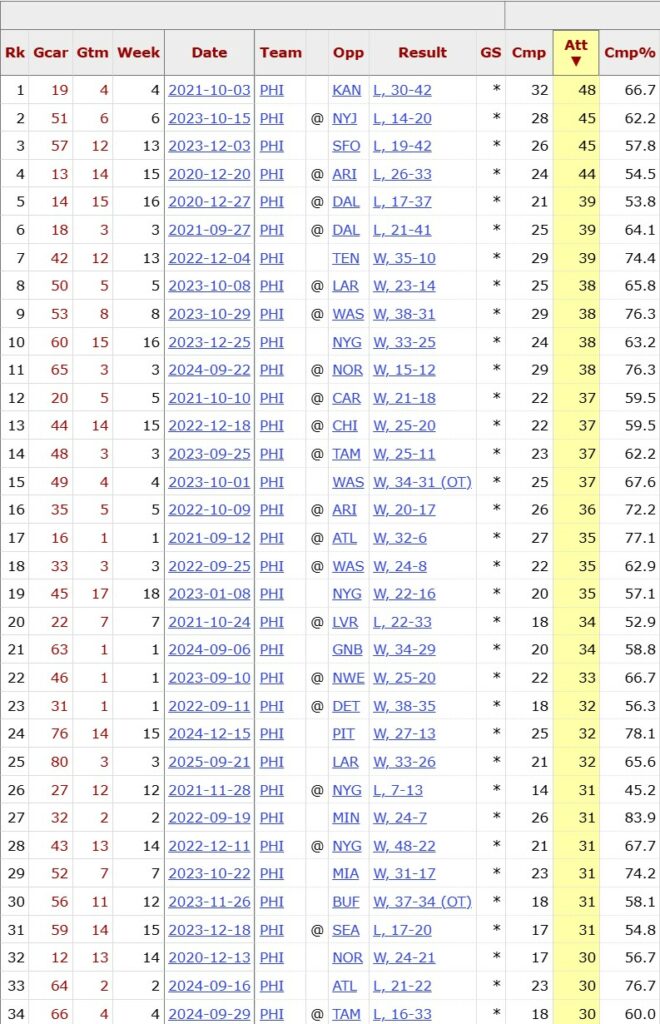
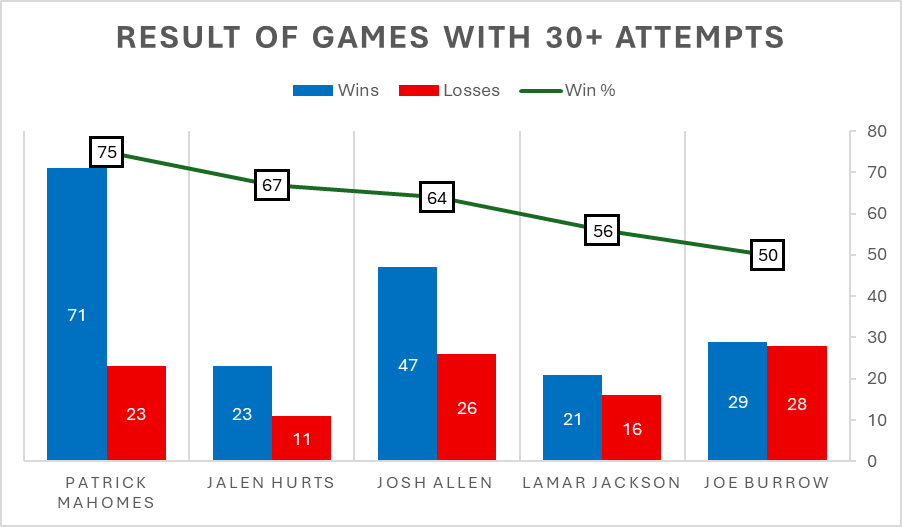
The national media’s crusade against Hurts often points to his inability to win games in the air. Hurts is plenty capable of throwing the ball to win a game. He is capable of taking over a game when he has to. He just doesn’t have to often because the Eagles are so good. Hurts’ career record when throwing the ball 30 or more times in a game, including playoffs, is 23-11. That is a 67.55% winning percentage.
Stats from Pro Football Reference.
Here’s at how Hurts compares to the country’s favorite elite quarterbacks.
Hurts is every bit as capable as the country’s “Top-4 Quarterbacks.” It is time for them to start including Hurts in that category. He does have more Super Bowl MVPs than all but one of the listed quarterbacks.
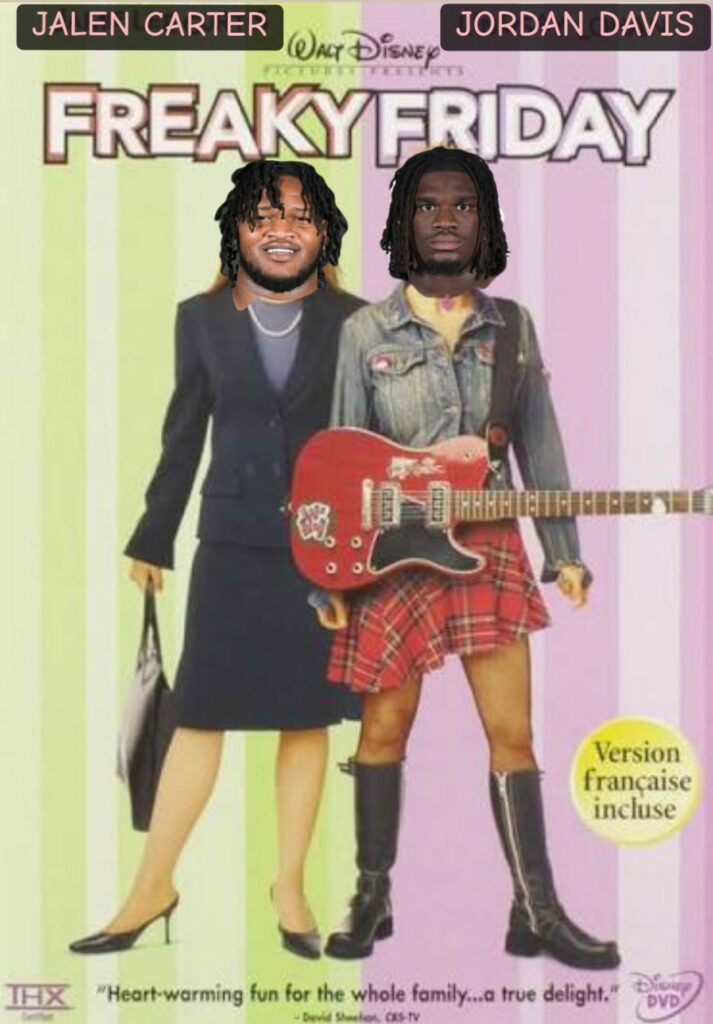
Defensive Tackle Freaky Friday
In an interview this past week, defensive coordinator Vic Fangio spent time talking about how Jalen Carter needed to get in better game shape. He didn’t provide much insight into why Carter was out of shape, but to Fangio’s point, Carter has not lit up the stat sheet this season.
Granted, he did miss an entire game (his own fault) and his impact on the field extends beyond just the counting stats, but rewatching games, he is not as sharp as he was last season.
On the other hand, Jordan Davis dropped 30 pounds this summer and has looked like the better player. Until this season, the issue with Davis was always his fitness level. He was a great player but just couldn’t stay on the field. It seems the two defensive tackles have swapped places.
I do not doubt that Jalen Carter will improve over the course of the season, but as he positively regresses back to his mean, we can hope that Jordan Davis continues his impressive play. Those two manhandling the interior offensive line will help solve the defense’s pressure problems.
Obviously, kudos to Davis for the thickest six of all time. I was watching from a Philly Sports bar in San Diego–Pretzels and Pints for those who are curious–and it was the loudest reaction I’ve ever heard with the exception of being in a stadium.
Offensive Offensive Line Play
Lane Johnson got a stinger on the Eagles’ first brotherly shove of the game. After the first series, the Eagles replaced him with Matt Pryor. Pryor struggled early and often. A few of the pressures he allowed may have been communication issues; one seemed to be a miscommunication specifically between Saquon Barkley and Matt Pryor that allowed an unblocked interior rusher.
Pryor’s final series resulted in the unblocked strip sack on Hurts.
The following series, the Eagles replaced Pryor with Fred Johnson, who immediately improved the offensive line.
Fred Johnson’s addition along the line provided immediate stability. He lost to Jared Verse on a few bullrushes that forced Hurts to get the ball out quickly, but that is expected of a backup RT against a premiere edge defender.
The Eagles said that Fred Johnson didn’t take the backup RT snaps at first because he had not taken snaps there in practice. That may be the case, but moving forward, the Eagles will likely have Fred Johnson take the backup snaps at both tackle spots.
The Rams clearly had a plan to take advantage of the backup tackles, whether it was Fred Johnson or Matt Pryor in at RT. They frequently sent extra rushers, either linebackers or defensive backs, at the right side of the offensive line to stress the Eagles’ sliding protections. It worked well and the Eagles offensive line struggled throughout the game. The offense did not provide with the offensive line or Hurts with easy outs against pressure.
This aligns with the first takeaway from this game; Kevin Patullo does not have answers for the blitz. Hurts has been better this season with combating the effects of blitzes, but he’s been doing so either by pushing the ball downfield or by picking up first downs with his legs. This offense has not had hot reads for Hurts to take advantage of really since he’s been the starting quarterback. It is a dangerous line to walk, one that produces either an explosive play or a sack. There is no easy answer for Hurts against the blitz. He’s been brilliant, but we can’t expect him to be otherworldly for the rest of the season. The answers to protect him and the offensive line must be built in to the offense.
Quinyanamo Bay
Quinyon Mitchell shadowed Davante Adams on 27 of 34 routes in Week 3 (79.4%). It was the first game of his career where he shadowed a receiver on over 60% of their routes.
Mitchell matched up against Adams 22 times after the snap, allowing just 2 receptions for 12 yards on 5… pic.twitter.com/1v6IyFjI1N
He has had two bad penalties this season, but outside of those two penalties, Mitchell has picked up right where he left off last season.
In this game, Mitchell shadowed Adams for most of the game, something that he has not been asked to do previously. He acquitted himself well. I won’t be surprised if he’s asked to shadow more often now. He essentially eliminates an entire third of the field.
That the Eagles have two young, talented cornerbacks is such a benefit to a defense that cannot pressure the quarterback. Once again, the Eagles will need to create coverage sacks. With Mitchell and Cooper DeJean, that is a viable strategy.
Defensive Line
Simply put, the Eagles rank 29th in the NFL in sacks. They have 3. Now, Josh Uche continues to be one of the best in the NFL in terms of pass rush win rate, but the sack total speaks for itself.
The indicating statistics are not much rosier. Between hurry, hurry %, pressure, pressure %, and sacks, the Eagles rank best in pressure %. They rank 15th in the NFL with a 19.4% pressure percentage. The defensive line is the weak link on the defense.
Nolan Smith just went on the IR. Azeez Ojulari has been a healthy scratch. Things are looking bleak for the edge rusher room. Despite the addition of Za’Darius Smith, the Eagles need to make a move for a needle-moving pass rusher before the deadline.
Considering teams that already look like they will miss the postseason, here are some names the Eagles should keep an eye on:
Danielle Hunter (Texans)
Bradley Chubb (Dolphins)
Leonard Floyd (Falcons)
Joseph Ossai (Bengals)
Jermaine Johnson II (New York Jets)
Skill Position Players
Throwing the ball to AJ Brown is a great idea. Brown is bigger, faster and stronger than almost everyone that is covering him. His ability to out-muscle defenders at the catch point is really unmatched in the NFL. The Eagles offense will continue to excel as long as they keep him and Smitty involved.
Saquon Barkley has not had a signature game yet this season, and as long as the Eagles continue to run condensed sets or run inside zone over and over, he probably won’t. I’m not so sure that defenses are selling out to stop Barkley as much as I am that the Eagles’ formations (both in terms of proximity to the ball in condensed sets and formation tendencies) invite added bodies in the box post-snap.
Patullo will need to start leveraging 11 personnel and spread the defense laterally to really get Barkley going; that is something this offense needs desperately.
The Philadelphia Eagles return to Lincoln Financial Field facing a familiar foe. The last time the Eagles played against the Los Angeles Rams in the Linc, it was during the NFC Divisional playoff game. The Rams gave the Eagles the greatest test of the postseason, ultimately failing to convert a critical fourth down with just seconds remaining. Saquon Barkley was the hero that day, scoring two touchdowns, one of which was his “snow bowl” moment.
Tomorrow, the two teams meet again, this time under much different circumstances.
Eagles Offense Vs. Rams Defense
Barkley was the answer in both games against the Rams last season. He had perhaps the two best games of his season. This season, the Rams defense features improved players along the defensive line. They were no slouches against the Eagles last season, but as just rookies, Jared Verse, Braden Fiske and Byron Young were still learning the ropes of the NFL. Now, after an entire offseason, the three sophomores figure to be an even bigger issue for the Eagles offensive line. They are aggressive, attacking upfield quickly to get after the quarterback. However, given Barkley’s dominance over the defense, I think that the Rams will take special care to shut down cutback lanes.
I expect that the Rams will devote more resources to the run. The Rams secondary is suspect. Their bid for success on defense is to be aggressive getting after the quarterback and using linebackers to fill the gaps of their aggressive defensive line (a theme I think will be common through most games of the Eagles season). They’re best bet is to try to stop every down within the first two seconds. Any play that lasts longer than that increases the exposure of their secondary. Expect plenty of negative plays but also plenty of explosive plays. If Hurts can navigate collapsing pockets and evade the first rusher, downfield shots should prove useful for the offense.
Eagles Defense Vs. Rams Offense
I often like to look at target charts for the opposing quarterback to see what the Eagles will try to take away first. Of course, this is Matt Stafford, and every week’s target chart is an even distribution at every level on portion of the field laterally. Stafford is such a good pure thrower of the football.
What he struggles in is mobility. As a 37-year-old quarterback, that isn’t much of a surprise. What is notable, though, is the Rams’ reliance on under-center drop backs. How the Eagles can take advantage is by rotating coverages as Stafford turns his back to the defense and then getting after him quickly.
What will be difficult for the Eagles is the dominance of the Rams’ receivers. It’s no secret that the Eagles’ incompetence at CB2 is the defense’s greatest weakness. Davante Adams is better than both Adoree Jackson and Jakorian Bennett. In isolation, Adams will simply humiliate the Eagles’ CB2 unless they receive significant help from the safety group.
The Eagles also do not have the sack production that would indicate taking advantage of Stafford’s immobility. What is encouraging is the Eagles pass rush win rate. They Eagles’ defensive line is winning; they are just not converting pressure to sacks. The immobility of Stafford should yield better results.
Prediction
The Eagles will not feast on the Rams defense on the ground like before. Kevin Patullo’s offense has been frustrating to say the least, and its lack of creativity will not provide the Eagles with easy answers. Any success they see will be a result of the players’ natural ability and dominance. The Ram’s defense is weak in the secondary. However, I don’t think that the Eagles will be able to block the Rams well enough to limit quick pressures. Receivers will therefore lack the ability to separate downfield and take advantage of the Rams’ poor secondary.
On defense, I expect the Eagles’ CB2 will be humiliated. McVay is still the standard for offensive scheming. Vic Fangio is the standard for defensive structuring, but the Eagles simply do not have the talent at CB2 to match the Rams’ firepower. They can protect that position with safety help, but safety help also means sacrificing structure in the rest of the defense.
I expect that the Rams will score early and often. Jalen Carter will get 2+ sacks, but ultimately it will not matter. Rams win 31-23.
Apologies for not writing a game review for the Cowboys game, and double apologies for not writing a pregame preview for the Chiefs. Life can be crazy. Regardless, I wanted to take some time to talk about what we have seen from the Eagles over the last two weeks.
He Just Wins
First and foremost, the Eagles are a winning franchise with Jalen Hurts under center. They start the season 2-0 after beating arguably their two greatest rivals—I count the Chiefs among their biggest rivals at this point—the first two weeks of the season. It has not looked pretty for the most part, but they get the job done. You may have seen the video of Chris Jones trying to discredit Hurts at the line of scrimmage as the Eagles lined up in victory formation. Jones tells Hurts, “You don’t even have 100 yards.” I won’t quote Hurts’ response; you can watch it for yourself. But he is exactly correct; the Eagles won the game.
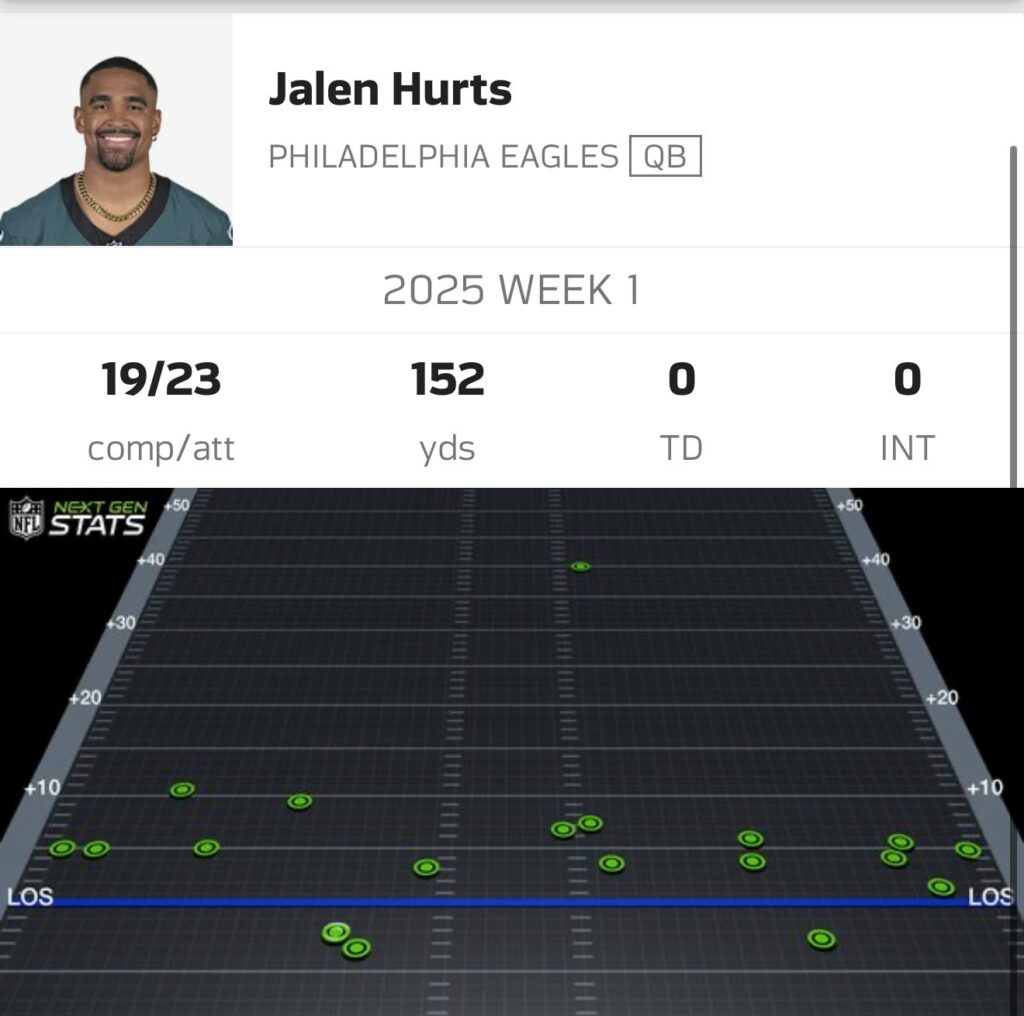
In Week 1, Hurts’ did exactly what you want to see from your franchise quarterback. Detractors point to his target map as a point of emphasis on his limitations as a passer.
I see the target map as a reason you paid the man to be your franchise quarterback. The Cowboys’ defensive coverage shells kept everything in front of them. They entirely eliminated the deep ball. What Hurts did was get the ball where it needed to be on time to take advantage of the intermediate and shallow areas of the field. Take what the defense gives you; Hurts did that and then killed the Cowboys with his legs. He was masterful against the Cowboys.
The Chiefs prioritized pressuring Hurts via blitzes. They blitzed the most they have under Steve Spagnuolo. Blitzes have long been the way to slow the Eagles offense, as the offense does not have the best answers when the quarterback is hot. But in this game, Hurts was decisive with the football, getting the ball out quickly.
The Chiefs blitzed Jalen Hurts on 16 of his 25 dropbacks (64.0%), their highest blitz rate under DC Steve Spagnuolo (since 2019).
Hurts is absolutely deserving of the praise he gets. He is willing this offense to wins they do not deserve.
Defense is Improved
The first half of the Cowboys game had most Eagles fans worried about the personnel lost in free agency during the offseason. They could not stop the run. Adoree Jackson was dreadful at CB2. Drew Mukuba was generally invisible. The defense settled in during the second half and certainly showed out today in Arrowhead.
The Eagles biggest question mark was pass rush. It was obvious that Eagles were simply not generating enough pressure despite Josh Uche having the best pass rush win-rate in the NFL in Week 1.
The Eagles were getting pressure but were held to zero sacks. Overall though, the results were poor.
Noticing the obvious shortfall, Howie Roseman went out and acquired Zadarius Smith, who was impactful immediately. He played well. The analytics will not be available for Week 2 for another day or two, but I anticipate the results on paper will be much better.
Though the pass rush looked better, Adoree Jackson was still challenged on most snaps. He is simply not the answer at CB2. The Eagles will need to get Jakorian Bennett out on the field sooner rather than later, or perhaps even make a move for a better option (that Bennett has not yet replaced Jackson on the depth chart is more than a little bit concerning). Jackson has been picked on in both games and has not even looked as bad as he actually has been. He was bailed out today twice on Patrick Mahomes overthrows. Fortunately, Mukuba looked every bit the playmaker he was billed as during the draft. He just missed out on a pick six after getting caught by the fastest offensive lineman sprint in years. His interception saved the game. He also had a massive stop against Hollywood Brown to kill a Chiefs drive. With CJ Gardner-Johnson gone, Mukuba will need to continue to be a physical force for the Eagles to continue performing well on defense.
If this Eagles team succeeds, it will be on the backs of their linebacking core. Jihaad Campbell is the perfect partner-in-crime for Zack Baun. His natural feel in coverage makes it so difficult for teams to throw over the middle for quarterbacks. I haven’t seen a target chart combining the first two weeks, but to my eyes, almost every target was along the sidelines, deep downfield or along the seams. Campbell even broke up a perfectly thrown seam-pass from Dak Prescott in Week 1. You have likely seen that clip of him “running the pole.” In addition to Campbell immediately looking like he belongs, Baun has not lost a step from his All-Pro season last year. He chased down Miles Sanders to save seven points in Week 1. That play was ultimately the difference.
Kevin Patullo Struggles
I will not pretend to be an offensive guru (though I like to think I know more than the average NFL viewer), so take this with a grain of salt: this offense looks uninspired.
My first thought is that the offense is not utilizing the full field. The Eagles seem to be running a lot of condensed sets which naturally loads the box against the run. There’s just more defenders closer to the ball. Saquon Barkley has not been bad at all, but the running game has been inefficient. Again, rbsdm.com will not have the EPA/play and Success Rate metrics until after tomorrow’s games, but I would venture to say the Eagles’ running game success rate will be below average. For a team that has the best offensive line and running back in football, that is unacceptable.
Contributing to their inefficiency on the ground is their predictability. Too often Patullo uses the same script each series: run into a loaded box, run into a loaded box, shallow pass to the boundary for little gain and punt. Every yard seems painstakingly hard to earn. Any success comes from the talent of the players. That has been enough these two weeks because the Eagles’ players are so talented, but teams more talented than the Cowboys and Chiefs, the margin for error will be so much smaller.
That AJ Brown has basically been a non-factor in both Week 1 and Week 2 is unforgiveable. He is among the five best players on the entire 53-man roster. He is a top-5 wide receiver in the NFL. Use him.
Similarly, when the Eagles have been in 3rd and more than 10, Patullo has had the Eagles take the cowards way out and run to punt. This is an offense with AJ Brown, DeVonta Smith, Saquon Barkley, the best offensive line in football, and a quarterback who throws the best deep ball in the NFL. Take advantage of the personnel and be aggressive.
It is early, but the early returns on Kevin Patullo are not inspiring.
Discipline
This whole offseason, we have heard about the Eagles as the model organization in the NFL. National pundits, players, coaches and team staff members all rave about how the Eagles prepare so intensely in the details. Where is the proof? The offensive line has killed drives with pre-snap penalties. The defense has surrendered first downs due to undisciplined taunting, not to mention the Jalen Carter spit-gate.
The Eagles have won by the skin of their teeth twice, but both games should not have been that close. Their discipline, or lack thereof, is a major factor in allowing the Cowboys and Chiefs to stick around in games they had no business winning.
Looking Forward
I will have a game preview this week as the Eagles prepare to play the Los Angeles Rams. I’ve been fortunate enough to go to the Eagles-Rams games the past two season in LA (I live in San Diego). It is a shame I won’t make it to the game at home this year, but fear not, my dad carries the torch for me and will give me some live reactions from the Linc.
In terms of the game itself, my initial thoughts are that the Eagles will need to win in a shoot-out fashion.
If the Eagles continue to play with Adoree Jackson on the field, Sean McVay is going to expose him with both Davante Adams and Puka Nacua. Stafford and the rest of the Rams’ offense looked much improved in Week 2.
On Thursday night, the Philadelphia Eagles will begin the defense of their title in Lincoln Financial Field against the Dallas Cowboys.
It’s one of the great football rivalries in the NFL, and the Eagles unveiling their new Super Bowl banner will likely add some fuel to the fire on the field. However, this game will have a much different feel than in recent years.
The two teams are in very different situations. The Eagles are champions and boast perhaps the best roster in the NFL. The Cowboys feature and a brand-new coaching staff and just traded their best player, Micah Parsons, to the Green Bay Packers.
The Eagles should win this game. They have the better offense; they have the better defense; they have the better coaching. But as the old adage goes, any given Sunday. Here is how the game will look on both sides of the ball.
Eagles Offense vs. Cowboys Defense
The biggest advantage the Eagles have remains their rushing offense. Jalen Hurts’ decisiveness and power carrying the football will always create opportunities for the running backs by forcing linebackers to respect his rushing ability.
The Eagles’ rushing offense was phenomenal in 2024. They ranked first in the NFL in rushing EPA with .056. As good as the Eagles’ rushing offense was, the Cowboys’ run defense surpassed it in rushing EPA allowed with .084. Simply put, opponents collectively ran better against the Cowboys than the Eagles did all season in terms of season totals.
During the 2024-2025 season, the Cowboys blitzed at the sixth highest rate in all of football. Their aggression on defense was partially why they were so ineffective against the run. Afterall, when you blitz, you risk blitzing the wrong gap. New Defensive Coordinator Matt Eberflus does not typically blitz as much, which may help stabilize their rush defense.
Now, the Micah Parsons trade is one-sided. There is no doubt about that. The Cowboys received only two first round picks and Kenny Clark in return. The Cowboys lost one of the three best pass rushers in the NFL and received little as compensation, but outside of contract structure and negotiation missteps, the trade makes sense structurally for the Cowboys’ defense. Clark may be coming off the worst season of his career, but he has historically been stout against the run in addition to his pass rushing ability. If he can return to his typical form, the Cowboys’ defense should improve against the run (it really can’t get worse, can it). If nothing else, the trade at least demonstrates a commitment to defending the run. Additionally, the Cowboys will play much of the season without linebacker Demarvion Overshown, who played well against the Eagles last season. To help linebackers Jack Sanborn and Kenneth Murray Jr., Eberflus will want to devote more resources to stop the run by loading the box and forcing Hurts to throw.
During the 2024-2025 season, the Cowboys’ defense was strong against the pass, primarily because of its pass rush. According to Pro Football Reference, they ranked third in sacks (52), boasting a 9.2% sack percentage, second in total pressures, and ninth in quarterback hits (105). Now, without Parsons to help disrupt the quarterback the Cowboys will need to their defensive backs to create opportunities for coverage sacks. Critically, the Cowboys return both DaRon Bland and Trevon Diggs, which should keep the Cowboys’ pass defense afloat.
The combination of a better coverage unit, the subsequent availability of resources to devote against the run, the lack of Micah Parsons, and the addition of Kenny Clark, you can expect the Cowboys to commit to stopping the Eagles on the ground.
As we’ve seen on the biggest stages, Hurts relishes the challenge to throw when defenses key on the run, and I think he continues to take advantage.
Eagles Defense vs Cowboys Offense
The Cowboys may be a far weaker team than we have grown to expect recently, but the decrease in talent is defensively. Their offense still features a passing game that will exploit tight windows and mismatches frequently. The Cowboys’ best chance at staying in this game is by leveraging new addition George Pickens. Pickens is perhaps the best second receiver the Cowboys have had in a long time.
As of right now, the Eagles plan to play Adoree Jackson at the second outside corner spot in order to keep Cooper DeJean in the slot.
Cowboys’ star receiver CeeDee Lamb also plays primarily from the slot, but since the Eagles rarely have their corners travel across the defensive formation and Cooper DeJean has played so well, the Cowboys could look to move their receivers around and exploit matchups. The addition of Pickens means that the Eagles will not be able to provide as much safety help over Lamb. If they do, they will have to hope their front seven can handle a decent run-blocking Cowboys’ offensive line.
Fortunately, the Cowboys’ backfield features Javonte Williams as the starter. The Eagles should be able to drop their linebackers often to help in coverage and play more two-high shells against the Cowboys to keep everything in front of them.
The Cowboys have done a good job at replenishing talent along their offensive line and without any star defensive linemen outside of Jalen Carter, expect the Eagles to struggle to pressure Dak Prescott. Until the postseason, the Eagles 2024 defensive line was among the worst in pass rushing statistics across the board. Most of their success was a result of incredible coverage from the defensive backs position group. Once again, the Eagles defensive backs will need to force coverage sacks.
Prediction
27-14 Eagles. The Eagles rarely play starters in the preseason, so the first few games often serve as a warm-up of sorts. They don’t typically come out firing on all cylinders.
I think that the Eagles’ roster construction is better, their coaches are more experienced, and they have the best home field advantage in the NFL. The Linc will be rocking on banner night, and I expect the Eagles will feed off of the energy. Hurts will leverage the open space in the secondary as the Cowboys commit to trying to stop Saquon Barkley.
I think this is a big Jordan Davis game. While he’s never been the difference making DT the Eagles dreamed he would be, he has been impactful against the run. As the Eagles devote more assets to stopping the Cowboys’ always-dangerous aerial offense, he will hopefully be the linchpin in stopping the run. I think he ends up with 2+ TFLs.
“I’ll tell you this. In any fight, it’s the guy who’s willing to die who’s gonna win that inch. And I know if I’m gonna have any life anymore, it’s because I’m still willin’ to fight and die for that inch.
Now I can’t make you do it. You got to look at the guy next to you. Look into his eyes! Now I think you’re gonna see a guy who will go that inch with you. You’re gonna see a guy who will sacrifice himself for this team because he knows, when it comes down to it, you’re gonna do the same for him!”
The line given by Al Pacino’s character, Tony D’Amato, in Any Given Sunday may just be a be a speech—albeit one of the greatest speeches of all time—from a sports movie, but the parallels between football, life and battle ring true for Sammie Adams.
Sammie is a First Lieutenant in the United States Marine Corps, and an excellent one at that. Sammie’s commander hand-selected him to lead a platoon of over 40 Marines and Sailors on a deployment to Australia. While there, he and his team of Marines became a close-knit group that trusted each other, potentially with their lives. Though they did not deploy to combat, as the “nation’s force in readiness,” the Marine Corps preaches tough, realistic training that prepares Marines for the rigors and tribulations of warfare. Sammie’s team was ready, and he owes it all to football.
The link between football and warfare dates back to its inception, and plenty of studies, books and articles equate them to one another. Bleacher Report, Sports Illustrated and the History News Network are just a few examples of publications that have correlated the two. Typically, authors associate the imposition of one’s will and the face-to-face alignment of the offense and defense to warfare of a bygone era, when troops would form a literal line and fire volleys at one another while marching straight towards each other.
But the elements of football that make Sammie such a great officer are vastly different than simply its structure. It is the discipline, preparation, adaptability and leadership that comes from a lifetime of playing football that enables his excellence in the Marine Corps.
Sammie played high school football at Kern Valley High School. It is a small school, with an enrollment of only 466 students. But even with such a small student population, Sammie was exposed to quality leadership that began to shape his own leadership style: leadership by example.
“I looked up to the captains of the team during my freshman and sophomore years and took the good qualities that they had and tried to emulate it. Really focusing on leading by example.”
By the time Sammie earned the role of team captain during his senior year, he was prepared for the responsibility. He had created a culture of accountability and setting the example.
“A lot of it was just holding my teammates accountable and leading from the front. Any conditioning workout we had, I would be the first one to show up no matter the situation. If I saw someone stop early or cut a corner, I would make the correction on the spot.”
In addition to being a strong leader, Sammie was unique in his adaptability. His coach, Coach Ben Goffinet, recognized that Sammie was a jack-of-all-trades and leveraged his adaptability.
“We changed his position around in high school. We used him to fit the needs of the team. We saw him as a jack-of-all-trades and could fill in gaps if anyone went down. We also built special packages for each team we prepared for. I think Sammie adapted well to new positions because he was a multi-sport athlete and had a baseline of going from sport to sport. That prepared him for switching from position to position.”
Sammie’s time in high school set the foundations for his future. Leadership, adaptability and preparation were the tenants he learned from football in high school that set the stage for his Marine Corps career.
While Sammie had offers to play football in college, he had an innate desire to serve. That is why he decided to attend the United States Naval Academy, the country’s premier leadership institution that graduates the most Naval and Marine Corps Officers every year.
Navy’s varsity football team spent time in AP’s Top 25 and was in the middle of recruiting some of the best athletes in program history; despite being a great player, Sammie was under no illusions he was going to walk onto the varsity team, but he still wanted to play the game he loved.
Instead, he chose to play for Navy’s Sprint Football team, which competes against eight other schools in the varsity Collegiate Sprint Football League. The CSFL follows the same rules as FBS Division I football, but with the unique twist that all players must be 183 pounds or less.
It was the league’s weight limit that forced Sammie to hone his discipline. Instead of simply being both larger and faster than his opponents, Sammie had to change the way he played and prepared. Every week, before game day, he would have to ensure he cut enough from his practice weight to make game weight.
Preparation was no longer simply watching tape, scouting, hitting practice reps and showing up for game day. It now included the discipline of monitoring weight, eating specific foods and weight cutting methods.
For four years, Sammie ate, slept and dreamed of football at the Naval Academy while also living and breathing leadership in preparation for leading Marines and Sailors after college. Sammie continued to utilize all he had learned throughout his years in football.
“You have your entire preparation phase and then execution on game day. Re-assess and learn from mistakes and the cycle begins again.”
After graduating from Navy in 2021 and receiving his commission as a Second Lieutenant in the United States Marine Corps, Sammie received orders to Camp Pendleton, CA to be a Logistics Officer. While initially receiving the billet of Assistant Operations Officer, his Battalion Commander quickly recognized Sammie’s propensity for inspiring leadership with enlisted Marines. He was hand-selected to lead a platoon in Australia from among the Battalion’s 12 other eligible officers. It was his moment to shine, and just as he had at Kern Valley High School and at the Naval Academy, Sammie ran with it.
Sammie’s platoon performed well in support of infantry units in exercises throughout Australia, receiving praise from units outside of his own. His adaptability, earned through years of football, allowed him to overcome challenges that would crush the will of most others.
Sammie’s Company Commander, Captain Pierre “Juice” Sajous had specifically high praise for Sammie.
“Sammie genuinely cared. He cared about the mission, he cared about improving, he cared about efficiency, but most importantly he cared about the Marines. We learn in Marine Corps Doctrinal Publication 1 about the art and the science of warfare and how the best results are achieved when the two ideals are both aligned. Sammie was able to seamlessly find that balance and translate it to the mission. Accompanied with a healthy dose of common sense, his thought process in execution was masterful.”
Without knowing all of Sammie’s backstory, Juice does correlate Sammie’s excellence with his time playing football at Navy.
“Its difficult to say where he was able to find his ability to balance the science and art of mission accomplishment without intimately knowing his history. It may have been upbringing or his training at the Naval Academy.”
In any case, Juice recognizes in Sammie the tenants that he learned playing football: accountability and leadership by example.
“The Marines absolutely adore Sammie. He took care of them. He worked hard for them and with them. He was never above doing the small things and ensuring they did all of the right stuff. He messed up now and then; he’s human. But each time something like that occurred, he would own up to his mistakes and try to fix them on his own or ask for help. He was never too proud to ask for advice. He showed great humility.”
Sammie and his platoon returned from their six months in Australia having trained and prepared for crisis response. Though they never had to answer the call, they had become a tight-knit team ready for anything. When asked how his platoon was so effective, Sammie provided a very football answer, “teamwork is how things get done. Discipline is a behavior that is built into someone. The bonds you build through blood and sweat go far deeper than you can imagine, so while it sucks at times, it is good to struggle through something together.”
Sammie’s time in Australia and at his first unit recently came to a close. His Marines and Sailors were upset to see him leave, but hopeful for what his career holds for him. His leaders likewise are excited to see how he progresses. Juice knows that he will excel in the future.
“Sammie has a promising career ahead of him. He will be a better leader than I could ever be. He may already be one. He’s smart, humble, reasonable, and an all-around great individual. I have no doubts he could hold command at the battalion or regimental level. All he really has to do is continue being true to himself and his unique leadership style.”
Sammie’s next step is returning to school at the Naval Postgraduate School in Monterey, CA, for a graduate degree in Operations Research, a prestigious and selective program. Though the job will be much different on a day-to-day basis, Sammie knows that in the end, if he can continue to apply the foundational tenants he learned playing football, he is ready to continue to excel, no matter what the future brings.
It’s just like watching tape and applying it to the next game. As Sammie says, “re-assess, learn from mistakes, and the cycle begins again.”